
Struggling to figure out what credit score is needed to buy equipment? Your credit score plays a huge role in getting approved for financing or leasing. This blog will break down how credit scores affect your chances, explain lender expectations, and highlight options even if your score isn’t perfect.
Stick around, it’s simpler than you think!
Key Takeaways
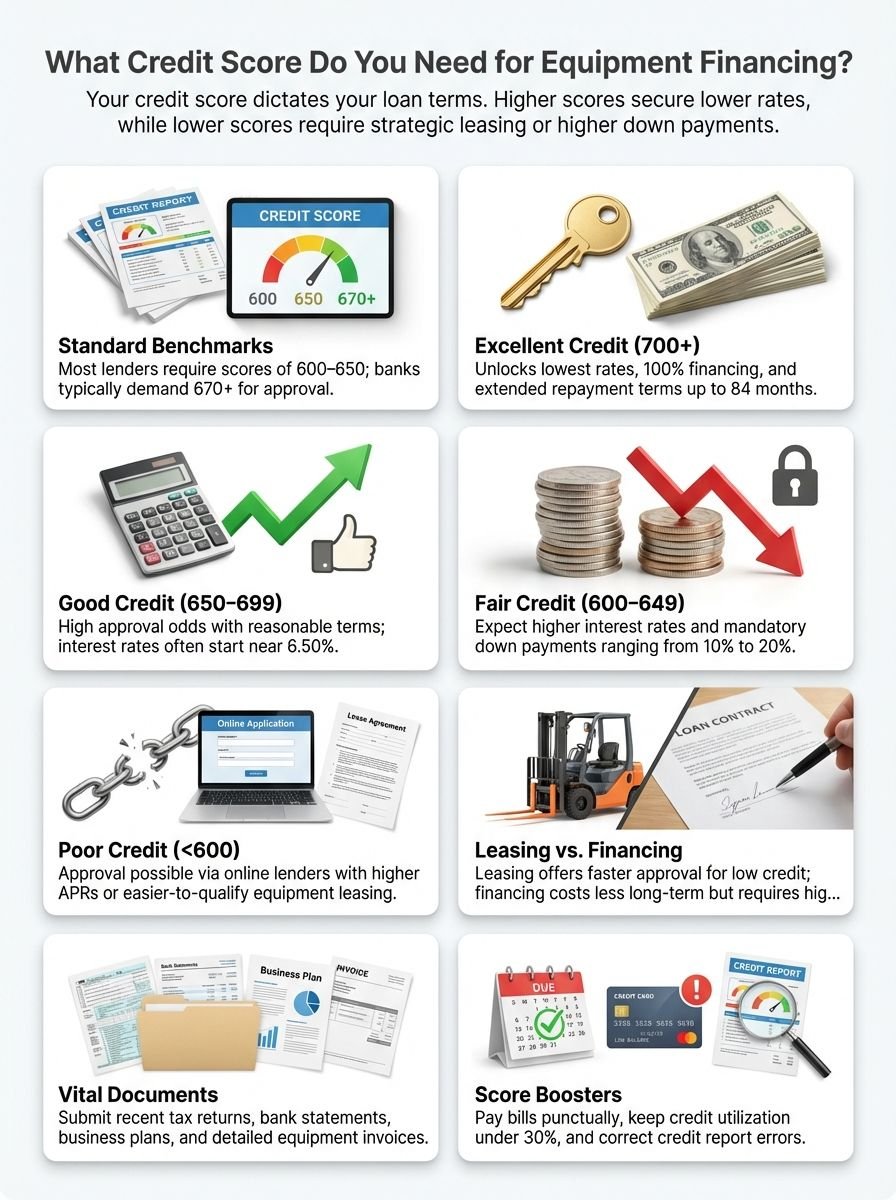
- Most lenders need a credit score between 600-650 to approve equipment financing. Banks prefer 670+, while online lenders may accept scores as low as 500 but with higher rates.
- Borrowers with 700+ credit enjoy the best terms, like low interest rates and longer repayment periods. For example, SBA 504 loans offer up to 10-year terms for top-tier applicants.
- Equipment leasing works better for lower-credit borrowers since it often avoids strict credit checks or large down payments. Approval can take just 1–2 days.
- Strong cash flow, stable income, and providing collateral boost approval odds even with lower credit scores. Lenders review tax returns, bank statements, and income records closely.
- Improving your score (e.g., paying bills on time or reducing debt) before applying helps secure better terms like lower interest rates or higher loan limits.
Minimum Credit Score Requirements for Equipment Financing
Most lenders ask for a credit score of 600 to 650 for equipment financing. Banks often set their bar higher, preferring scores above 670. Online lenders may approve scores as low as 500, but this comes with higher interest rates and smaller loan amounts.
Equipment leases can be an option if your credit is weaker. Leasing companies tend to work with lower scores compared to traditional loans. Some businesses also meet other requirements like making $100k–$250k annually or being in business for at least one or two years.
Credit Score Tiers and Their Impact on Approval
Your credit score acts like a report card for lenders. It can sway loan approvals, terms, and rates quicker than you’d expect!
Excellent Credit (700+): Benefits and Advantages
Borrowers with excellent credit scores (700+) enjoy the best equipment financing options. Banks and lenders offer low rates, higher loan amounts, and longer repayment terms to such applicants.
For example, U.S. Bank provides loans up to $2.5 million for high-credit borrowers, while Wells Fargo offers 100% financing on loans over $100,000 with terms ranging from 12 to 84 months.
A strong credit score can also reduce or even eliminate down payment requirements. SBA 504 loans cap interest rates and extend repayment periods up to 10 years for top-tier applicants.
This saves businesses money upfront and over time. With excellent credit, you gain access to the largest funding opportunities available in the market today.
Good credit is an investment that pays off big-time when buying business equipment.
Good Credit (650-699): What to Expect
Lenders see good credit as lower risk. With a score between 650 and 699, you can often secure equipment financing with reasonable terms. Interest rates may start around 6.50% for some banks like Bank of America.
Loan amounts may go up to $2.5 million if your business has been running for at least two years.
Approval is likely, but costs may be higher compared to excellent scores. Expect loan terms of 24 to 60 months or more based on your lender’s policies. Fees like origination charges are usually lower for this range, such as the 0.50% fee offered by some lenders.
Fair Credit (600-649): Challenges and Opportunities
Fair credit can open doors to equipment financing but comes with hurdles. Many lenders set a minimum score of 620 for loans, leaving little room for error. Expect higher interest rates, making loans costlier over time.
Rates may reach 4.99% or more depending on the lender and loan term.
Some businesses must provide a down payment ranging from 10% to 20%. A strong business history can help offset risks. For example, annual revenue of $100,000 or more and at least one year in operation improve approval odds.
Online lenders often approve applications within 24-48 hours if these criteria are met. Careful planning helps navigate stricter terms and costs tied to fair credit scores.
Poor Credit (Below 600): Options for Approval
A credit score below 600 limits options but doesn’t close the door. Online lenders might still approve applications with scores as low as 500, though rates can climb to 40% APR. Taycor Financial offers loans up to $400,000 for poor credit borrowers with terms from 4–60 months and rates starting at 6.75%.
Equipment leasing is a great option for individuals in this range since it often avoids strict credit checks. Some leases may not even require a down payment, although costs will be higher as a whole.
Manufacturer financing or merchant cash advances are other possibilities but come with trade-offs like smaller approval amounts and high fees.
Equipment Leasing vs. Equipment Financing: Credit Score Considerations
Equipment leasing often works better for businesses with lower credit scores. Leasing companies tend to approve applications faster, sometimes in just 1–2 days. They also usually don’t need a down payment, making it easier for startups or cash-strapped businesses.
This option is helpful if your business has subprime credit or faces challenges qualifying for traditional loans.
On the other hand, equipment financing requires stronger credit history. Lenders may ask for scores above 650 to secure favorable terms. Loans might also call for collateral or a higher down payment upfront.
While this route can cost less over time, it’s not as friendly toward lower credit ratings compared to leasing options like operating leases or rent-to-own agreements.
Factors Lenders Evaluate Beyond Credit Scores
Lenders look at more than just your credit score. They care about how stable your income is and if you have assets to back the loan.
Income Stability and Cash Flow
Banks check tax returns from the past three years and recent bank statements. They want to see steady income before approving equipment loans or leases. Seasonal businesses face more questions about revenue consistency.
Strong cash flow boosts your chances of approval. Borrowers need enough money coming in to cover monthly payments, like a $500 lease for equipment generating $1,000 a month in extra revenue.
Lenders often review income statements and balance sheets to confirm this ability.
Collateral and Down Payment Options
Equipment loans often use the equipment itself as collateral. This protects lenders by reducing risk if payments are missed. For those with poor or fair credit, lenders might ask for extra guarantees like personal assets.
A down payment of 10–20% is common, especially for expensive machinery or low-credit applicants. Some loans cover up to 100% of costs, while others go higher to include fees. Older equipment may need higher upfront payments due to its lower value over time.
Alternatives for Low Credit Scores
Struggling with a low credit score doesn’t mean you’re out of options. Certain strategies can still help you secure the equipment your business needs.
Co-Signers or Guarantors
A co-signer or guarantor can boost your chances of equipment financing approval. Lenders may approve loans for low credit scores if a trusted person with strong credit joins the application.
This helps reduce the lender’s risk and could lead to better terms, like lower interest rates.
Guarantors are often needed for high-risk loans or large amounts. For example, if you want to buy heavy equipment but have poor credit, adding a co-signer might make it possible. They agree to take over payments if you default, so they must have solid finances.
Specialized Lenders for Bad Credit Financing
Taycor Financial is a top choice for businesses with poor credit. They offer equipment loans up to $400,000, with interest rates starting at 6.75%. Triton Capital provides flexible plans and quick funding.
You can get between $10,000 and $250,000 within 48 hours. Their process works well for various credit scores.
National Funding helps newer businesses too. They accept companies as young as six months old, offering loans of up to $150,000 with rates from 4.99%. Merchant cash advance providers are another option if your business has steady sales but low credit scores.
These lenders base approval on future sales instead of your credit history.
How to Improve Your Credit Score Before Applying
A higher credit score can get you lower rates and better equipment financing terms. Improving your score takes effort, but it’s worth it.
- Pay your bills on time. Late payments hurt credit the most. Set up automatic payments or reminders to stay consistent.
- Lower your credit card balances. High credit utilization lowers scores. Aim to keep usage below 30% of your limit.
- Check your credit reports for errors. Mistakes happen, and they can cost you points. Dispute incorrect information through the credit bureau.
- Avoid opening too many new accounts at once. Each inquiry dings your score slightly, so apply only when necessary.
- Keep old accounts open, even if unused. Length of credit history matters, so maintaining older accounts helps boost your score.
- Separate business and personal finances clearly. Lenders prefer clean records, which makes applications smoother and quicker.
- Build a strong cash flow record for your business. Healthy income shows lenders you’re reliable, even if your score needs work.
- Limit large purchases before applying for financing equipment loans or leases! Big debts raise risk in lenders’ eyes.
- Reduce outstanding debt gradually over time instead of carrying high balances consistently; this shows financial responsibility to creditors.
Key Documents Required for Equipment Financing Applications
Securing equipment financing requires thorough preparation. Lenders need specific documents to assess your business’s capability to repay the loan.
- Equipment Invoice
Provide an invoice that includes the full cost of the equipment. Incorporate soft costs such as taxes, delivery fees, and installation charges. - Recent Tax Returns
Submit your business tax returns from the past three years. This allows lenders to verify income stability and financial history. - Business Plan
Present a clear written business plan that explains your goals and how you’ll use the equipment. Lenders value proof of strategy and growth potential. - Balance Sheet
Share your current balance sheet with detailed information about assets, liabilities, and shareholder equity. It highlights your company’s financial health. - Income Statements
Provide income statements covering at least two previous years. These reflect revenue trends and profitability over time. - Bank Statements
Include bank statements for the last 12 months or more if needed. These provide insight into cash flow and spending patterns. - Accounts Receivable Details
Share records of accounts receivable to demonstrate consistent incoming payments from clients or customers. - Business License or Registration
Supply a copy of your business license or proof of registration to confirm legal operations under state or federal regulations. - Identification Documents
Submit valid government-issued ID and potentially Social Security numbers for verification purposes during the application process. - Proof of Collateral (if needed)
Offer documents proving ownership or value for any collateral you are offering against the loan, such as property titles or other assets.
Tips for Choosing the Right Lender or Leasing Partner
Finding the right lender or leasing partner can greatly influence your equipment financing experience. Take your time and follow these tips to secure the best deal for your needs.
- Check credit score requirements before applying. Some lenders require a personal credit score of 670 or higher, while others may accept 500 or above. Knowing this saves time and avoids rejections.
- Research loan terms carefully. Traditional banks often provide lower rates but stricter rules, while online lenders offer faster approvals with higher costs.
- Explore industry-specific options. Equipment manufacturers sometimes have in-house financing that works well for small businesses needing new equipment quickly.
- Compare interest rates thoroughly. Some online loans may charge up to 40% APR, which can add thousands to the total cost over time.
- Verify funding speed if you need equipment quickly. Options like Southern Bank approve loans within one day, while SBA loans may take longer but have capped rates.
- Review any extra perks offered by lenders. Long-time customers might receive better terms or discounts from certain banks.
- Confirm flexibility in repayment terms. Monthly payments customized to cash flow are crucial for startups managing tight budgets.
- Ask about collateral requirements upfront. Some lenders secure the loan with the equipment itself, making approval simpler for low-credit borrowers.
- Read reviews on trusted platforms like Funding Circle and Business News Daily to avoid hidden fees or poor service quality.
- Seek assistance from advisors if unsure about options like SBA 504 loans or vendor financing packages; they can clarify decisions without unexpected issues later on!
Common Mistakes to Avoid in Equipment Financing Applications
Applying for equipment financing can be tricky. Small mistakes might hurt your chances or cost you more in the long run.
- Not gathering all documents
Missing tax returns, financial statements, or business plans slows down approvals. Lenders may require these to evaluate your finances. - Overestimating revenue
Guessing high income without proof raises red flags. Be honest about cash flow and debt-to-income ratios. - Ignoring expenses
Downplaying costs creates problems later. Monthly payments can pile up if you don’t plan correctly. - Skipping ROI calculations
Failing to check return on investment (ROI) can lead to losses. Compare the equipment’s cost to future earnings carefully. - Buying unnecessary equipment
Getting more than you need wastes money and reduces approval odds. Be clear about what equipment your business requires. - Overlooking lender terms
Not reading loan or lease agreements fully might lock you into bad deals. Watch out for hidden fees, penalties, or high interest rates. - Forgetting budget limits
Ignoring how much you can afford each month harms cash flow. Stick to a payment that fits your finances comfortably. - Applying with no collateral
Lenders often prefer loans secured by assets like vehicles or real estate. Without collateral, expect stricter requirements or higher rates. - Choosing the wrong lender
Going with lenders unfamiliar with small businesses can hurt approval chances. Research those who specialize in business credit needs. - Rushing applications
Submitting incomplete forms delays processing or leads to denial altogether. Take time to double-check details before applying!
What Credit Score is Needed to Buy a Dump Truck: A Specific Case Study in Equipment Financing
Most lenders look for a credit score of at least 600 to approve dump truck financing. Traditional banks often prefer scores above 670, especially for heavy equipment loans like this.
For borrowers with fair or poor credit (500-649), online lenders may still offer options, though higher interest rates are likely.
A down payment of around 10-20% is typically required for lower-credit borrowers seeking dump truck loans. Having over $100,000 in annual revenue and more than two years in business boosts approval chances greatly.
SBA loans (like the CDC/504) might help too but can take up to eight weeks for approval. Loan amounts range from $10,000 to $2.5 million based on the lender and applicant’s profile.
Frequently Asked Questions About Equipment Financing and Credit Scores
Equipment financing often raises many questions. Below, you’ll find clear answers to the most common ones.
- What credit score do you need for equipment financing?
Lenders usually prefer scores above 600. Banks may ask for 670 or higher. - Can people with bad credit still finance equipment?
Yes, some lenders work with scores below 600. Rates might be higher, though. - How much are interest rates on equipment loans?
With good credit, rates start at 6%. Poor credit can see rates as high as 40%. - Is collateral required for equipment financing?
Often, yes. The equipment itself serves as collateral, reducing risks for lenders. - How fast is approval and funding?
Online lenders may approve loans in 24 hours. Banks usually take longer. - What documents are needed to apply?
Commonly required are tax returns, a business license, financial statements, an invoice for the equipment, and a solid business plan. - Does leasing equipment also require a credit check?
Yes, most leasing companies review your score before approval. - Can startups get approved for these loans?
Startups face more challenges but may qualify with strong business plans or co-signers. - Are there alternatives if denied by a bank?
Yes, options like leasing or merchant cash advances can still help secure necessary tools. - Do personal and business credit scores both matter?
Both often play a role; weak personal credit could affect your chances unless your business profile is strong enough on its own. - What happens if I miss payments on an equipment loan?
The lender may seize the financed equipment since it acts as collateral. - Are there tax benefits with equipment financing or leasing?
Often yes! Leases and loans may offer deductions when filing IRS tax forms based on depreciation or monthly payments tied to business expenses.
Conclusion: Navigating Equipment Financing with Confidence
Buying equipment can feel tricky, but with the right credit score, it’s possible to secure good financing options. Lenders look at your credit and other factors like income or collateral to decide.
If your score isn’t great yet, improving it before applying can open better doors. Research lenders carefully, know your needs, and avoid hasty choices. The right plan gets you closer to growing your business!
For more detailed insights into securing financing for specific equipment, check out our comprehensive guide on what credit score is needed to buy a dump truck.
FAQs
1. What credit score is needed to qualify for equipment financing?
Most lenders prefer a personal credit score of at least 600. However, businesses with low credit scores can still find options, though they may face higher interest rates or stricter terms.
2. How does my business’s credit score affect equipment financing?
Your business’s credit score shows your financial reliability. A higher score often leads to better financing terms and lower rates, while a lower score might limit the options available.
3. Can I lease equipment if I have bad credit?
Yes, leasing can be an option for businesses with bad credit. Equipment leasing allows you to use the equipment without buying it outright and may require less stringent qualifications than loans.
4. Is collateral required when securing heavy equipment financing?
In many cases, the type of equipment you’re purchasing serves as collateral for the loan or lease. If payments aren’t made, lenders could seize the equipment as repayment.
5. Are there benefits like tax advantages in using equipment finance?
Yes, certain types of leases or loans offer tax advantages that can reduce overall costs for your business while helping you get the right equipment you need.
6. How do startups qualify for financing their first piece of equipment?
Startups may rely on personal credit scores instead of established business finances when applying for lines of credit or loans to purchase their first piece of capital-intensive machinery or tools needed to operate effectively.
