
Understanding Credit Scores for Semi-Truck Financing
Credit scores play a big role in semi-truck financing. Lenders use them to check how risky it is to loan you money. Most scores range from 300 to 850, with higher numbers being better.
A good score can mean lower interest rates and easier approval for loans.
Semi-truck loans are often secured by the truck itself. This means if you don’t pay, the lender can take the truck back. Small businesses make up over 95% of the trucking industry, so lenders know many borrowers are owner-operators or new business owners.
Proof of insurance and having a Commercial Driver’s License (CDL) also matter along with credit history.
Minimum Credit Score Requirements
Your credit score plays a big role in getting approved for semi-truck financing. Lenders set minimum scores, and knowing where you stand can open or close doors to your trucking dreams.
Credit score ranges and their impact on financing options
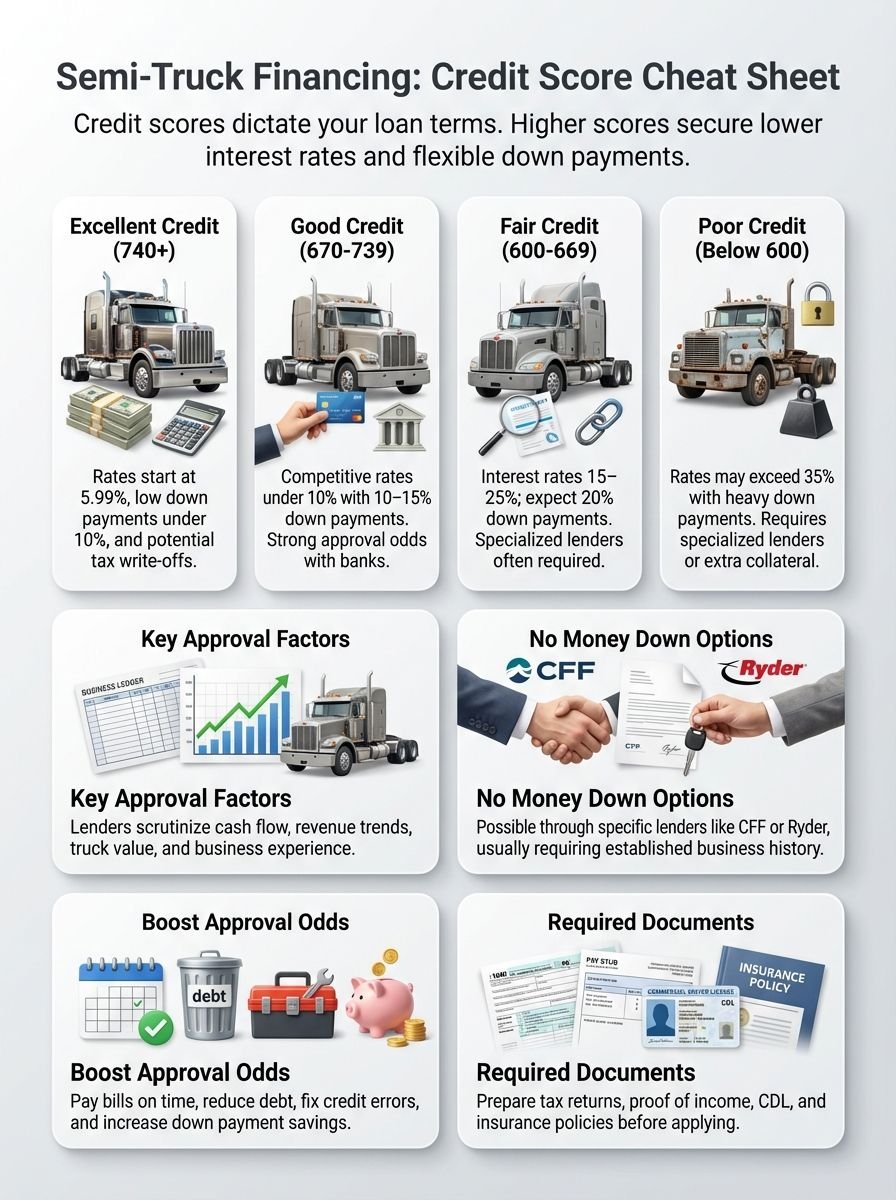
Credit scores play a huge role in semi-truck financing. Lenders evaluate your score to determine loan terms and interest rates. A higher credit score generally opens doors to lower interest rates, while lower scores lead to costlier financing. Here’s a breakdown of the credit score ranges and their effects on financing options.
| Credit Score Range | Impact on Semi-Truck Financing |
|---|---|
| 740 and above (Excellent) | – Lowest interest rates, often starting at 5.99%. – Favorable loan terms with longer repayment periods. – Typically requires less down payment, around 10% or less. – High likelihood of approval with traditional lenders. |
| 670 – 739 (Good) | – Competitive interest rates, although slightly higher than excellent credit rates. – Decent loan terms, often requiring a down payment of 10-15%. – Approval with most traditional lenders remains strong. – Moderate business documentation may still be required. |
| 600 – 669 (Fair) | – Interest rates range between 15-25%, depending on other factors. – Down payment requirements increase, often between 15-20%. – Specialized lenders may be a better fit compared to traditional ones. – Qualification likely hinges on additional elements, such as revenue or collateral. |
| Below 600 (Poor) | – Interest rates often exceed 35%, making financing costly. – Lenders typically ask for a higher down payment, sometimes up to 30%. – Few traditional lenders offer options, so alternative financing is more common. – May need to explore no down payment loans, which carry steep terms. |
These credit score ranges determine everything from how much you’ll pay in interest to whether you’ll even get approved. Even if your score is less-than-ideal, options still exist, but they come with added costs or stricter conditions. Having all the numbers in front of you can help make smarter decisions before applying.
Typical minimum scores for traditional vs. specialized lenders
Some lenders play it safe with higher credit score requirements. Others are more flexible, opening doors for borrowers with weaker credit. Here’s a clear comparison between traditional and specialized lenders:
| Lender Type | Minimum Credit Score | Additional Requirements |
|---|---|---|
| Traditional Lenders (e.g., Banks, Credit Unions) | 670+ | Often require strong business financials or a significant down payment. |
| Truck Lenders USA | 675+ | At least 2 years in business. |
| Specialized Lenders (e.g., CAG Truck Capital) | Flexible, typically work with scores below 600. | Can approve borrowers with bankruptcies or poor credit history. |
| Smarter Equipment Financing | 550+ | Requires 3+ years of driving experience and 2+ years in business. |
| Freedom Truck Finance | Not for poor credit. | Requires a 20% down payment. |
| Wells Fargo | 600+ | Requires an established business history. |
Traditional lenders, like banks, tend to favor borrowers with stronger scores. Specialized lenders, on the other hand, make room for flexibility. This includes helping individuals with bad credit or unique financial situations.
Credit Score Tiers and What They Mean for Financing
Your credit score plays a big role in the loan terms you’ll get. Higher scores can unlock lower rates, while lower ones may lead to steeper costs.
Excellent Credit (740+): Benefits and terms
Borrowers with a credit score of 740 or higher receive the most favorable financing offers. Lenders may provide interest rates as low as 5%. Some offer terms up to 84 months with 100% financing, meaning no down payment is required.
Banks and credit unions frequently provide lower rates and extended repayment terms to individuals with excellent credit.
Achieving this score also allows access to capital leases that result in ownership of the semi-truck. Truck depreciation and loan interest are often tax deductible, which can save money during tax season.
Referencing Section 179 tax rules enables a full write-off on qualifying purchases in certain situations:.
Section 179 lets you deduct the entire purchase price of eligible equipment purchased during that year.
Strong credit assists in keeping costs manageable while effectively building business assets like semi-trucks over time!
Good Credit (670-739): Competitive options available
A credit score of 670 to 739 makes semi-truck financing more affordable. Lenders often give lower interest rates, sometimes below 10%. Banks and credit unions prefer borrowers in this range and may offer smaller down payments, usually around 10% to 15% of the truck’s cost.
For example, SMB Compass offers loans up to $5 million with terms as long as ten years for scores above 650. This range also provides flexibility whether you want a used truck costing $50,000 or a new one priced at $120,000-$150,000.
Good credit can save you money over time through better terms and options.
Fair Credit (600-669): Common threshold for approval
Having a fair credit score of 600–669 is often enough to get semi-truck financing. Traditional lenders usually accept this range, but the terms might not be ideal. A down payment of about 20% is typically required for borrowers in this tier.
Interest rates can run higher, ranging from 10% to 20%.
Alternative lenders are more flexible with these scores. Some approve loans even with scores on the lower end of fair credit. Companies like National Funding may offer loans up to $150,000 for those with a minimum score of 575 and no down payment needed.
Applications often require financial records, truck details, and proof of insurance—so have those ready before applying!
Poor Credit (Below 600): Alternative financing possibilities
A credit score below 600 doesn’t close all doors for semi truck financing. Specialized lenders like CAG Truck Capital and Smarter Equipment Financing may approve applicants with poor credit.
For example, Smarter Equipment Financing works with scores as low as 550. These loans often require higher down payments, ranging from 10% to 40%. Interest rates can climb up to 35%, making monthly payments larger.
Dealer or in-house financing is another possibility for buyers with bad credit. Commercial Fleet Financing (CFF) provides loans even without good credit and offers same-day approvals with funding within 24 hours.
You might need extra collateral or more paperwork to secure the loan, but approval is doable. Many of these options are better suited for used trucks rather than new ones due to lower costs upfront.
Additional Factors Lenders Consider Beyond Credit Scores
Lenders also check your business earnings, down payment size, and truck value—there’s more to it than just credit scores!
Business financials, cash flow, and revenue
Strong business financials improve your chances of approval. Lenders often review cash flow, revenue trends, and past tax returns. Healthy finances show you can handle monthly payments for the semi-truck loan.
Positive cash flow is key to proving stability. Businesses with steady revenue are less risky for financing companies. For newer trucking businesses or first-time buyers, sharing a solid business plan can strengthen your application.
Importance of down payments and collateral
A solid down payment can save you money. Most lenders ask for 10% to 20%, though some go as low as 0%. Larger down payments reduce your loan balance, decreasing monthly payments and total interest costs.
For new trucks, lenders often require less upfront compared to older or high-mileage trucks.
Collateral secures the loan if you default. The semi-truck itself serves as the primary collateral. Lenders might ask for additional assets like cash or property in cases of poor credit.
Make sure the truck meets their requirements; used ones over ten years old or with more than 700,000 miles may not qualify.
Options for Semi-Truck Financing with No Money Down
Some lenders offer semi-truck financing with no money down. These options can help truck drivers or business owners start without a large upfront cost.
- Commercial Fleet Financing (CFF) provides no money down loans for businesses already running. This helps experienced companies add to their fleet without draining cash reserves.
- Smarter Equipment Financing works with applicants who have credit scores of at least 550. It’s suitable for those needing flexible terms despite a lower credit score.
- Ryder offers used truck financing plans requiring zero down payment. Their deals even allow smaller payments for the first three months, easing financial pressure early on.
- US Bank approves no down payment loans up to $150,000 through its application-only programs. It’s fast and skips heavy paperwork, ideal for quick purchases.
- CAG Truck Capital specializes in working with poor credit borrowers and older trucks. They provide no money down options even if the vehicle has high mileage.
- Volvo Financial Services delivers up to 100% financing on new or certified used trucks. This works well for buyers wanting reliable vehicles without advance payments.
These lenders often ask for proof of strong business financials or higher interest rates on loans to cover risks.
Improving Your Chances for Semi-Truck Financing Approval
Getting approved for semi-truck financing can feel challenging, but it’s achievable with the right steps. Focus on strengthening your finances and preparing well.
- Pay all bills on time every month. Late payments hurt your credit score, so paying on time builds trust with lenders.
- Lower your debt as much as possible before applying. High debts make lenders doubt your ability to repay a loan.
- Save money for a bigger down payment. A larger upfront payment reduces the loan amount and makes approval easier.
- Check your credit report for errors and fix them fast. Mistakes in your report can lower your score unfairly.
- Build business credit by opening lines of credit under your company’s name and making regular payments.
- Gather key documents like tax returns, proof of income, CDL certification, and insurance policies before applying.
- Showcase at least two years of steady trucking experience or business history to boost lender confidence.
- Consider buying through a dealer that works with lenders directly; they may have better financing options available.
- Research specialized lenders if you have bad or fair credit instead of traditional banks that require higher scores.
- Keep insurance plans updated, including coverage types like Primary Liability and Cargo Coverage; this is often required before approval.
Conclusion: Securing Financing with the Right Credit Score
A strong credit score opens doors for better semi-truck financing. Aim for a score of 670 or higher to secure decent terms. If your score is lower, don’t lose hope! Explore lenders that work with fair or poor credit, and focus on making on-time payments to improve your chances over time.
The right loan can get you rolling down the road toward success.
FAQs
1. What credit score do I need to get semi-truck financing?
Most lenders require a credit score of at least 600 to qualify for semi-truck financing, but higher scores improve your chances of approval and better loan terms.
2. Can I finance a semi-trailer truck if my credit isn’t great?
Yes, it’s possible to buy a truck with lower credit, but you may face higher interest rates or need to provide collateral like the truck itself.
3. Do lenders have other requirements besides my credit score?
Lenders often ask for proof of income, time in business, and an Employer Identification Number (EIN). Some also look at on-time payments and other financial details.
4. Should I lease or buy a semi-truck if my credit is low?
Leasing could be an option if your credit risk is high since it might have less strict requirements than financing new or used trucks outright.
5. How can making on-time payments help me secure better loans in the future?
Consistent on-time payments build positive credit history and lower your debt-to-income ratio, which improves your chances of getting approved for better financing solutions later.
6. Are there specific loans available through programs like the Small Business Administration (SBA)?
Yes, SBA loans are available as small business loans that offer owner-operators competitive rates when purchasing commercial vehicles such as semi-trucks in the United States.
