
Do you want to know what credit score you need to buy a skid steer? Credit scores are key for lenders when deciding on loans. This guide explains the typical credit requirements and how to boost your chances of approval.
Stay tuned, it’s worth reading!
Key Takeaways
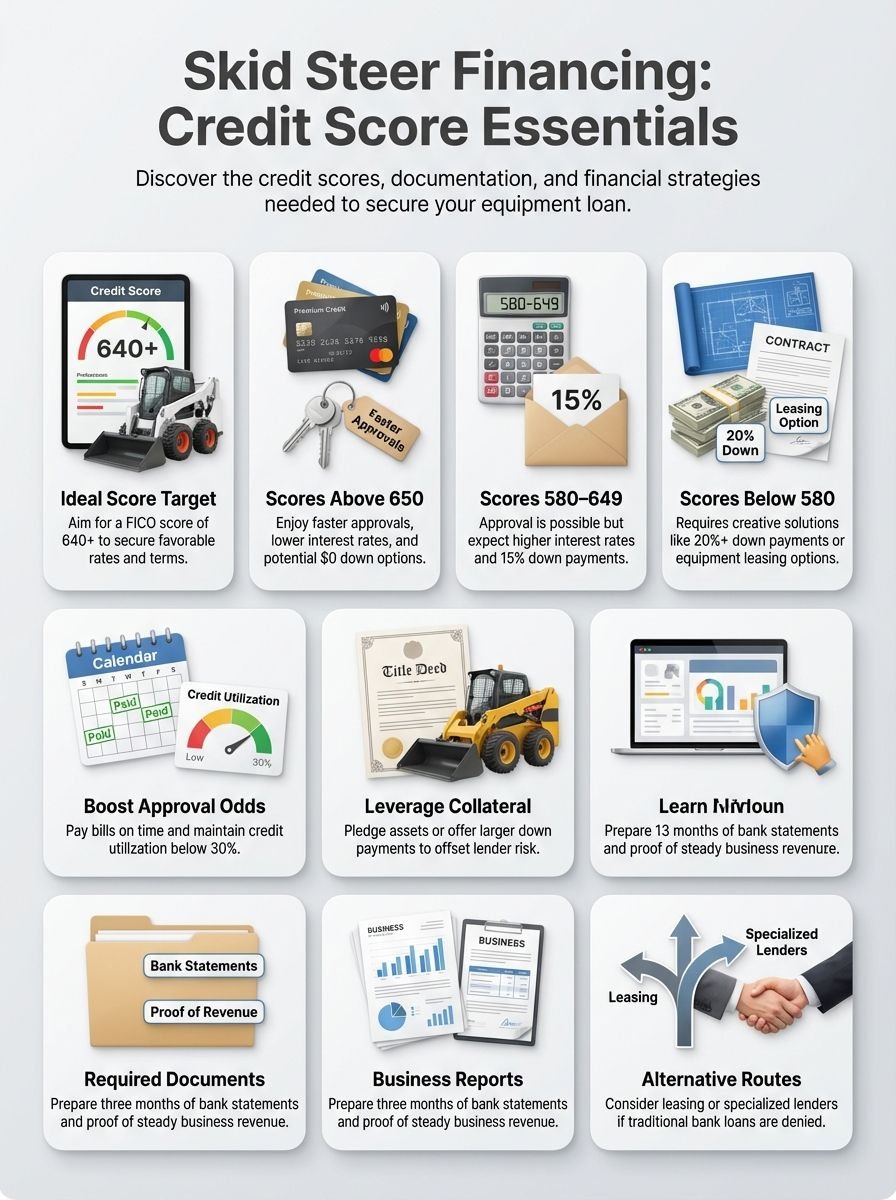
- A credit score of 640 or higher is usually needed for skid steer financing, with better terms offered to those above 650. Scores in the mid-500s may qualify but face stricter conditions like higher rates or bigger down payments.
- Lenders check both personal (tied to your Social Security number) and business credit (linked to your EIN). Stronger scores improve chances for approval and lower costs.
- Specialized equipment lenders approve loans for moderate or poor credit, often requiring collateral, larger down payments, or more documentation like bank statements.
- Leasing is a good option if you have low credit since it needs less upfront money and offers flexible payment plans without requiring large collateral.
- Preparing documents like tax returns, proof of income, personal/business credit reports, and using financing calculators improves loan planning and speeds up approvals.
Minimum Credit Score for Skid Steer Financing
A credit score of 640 or higher is often required to finance a skid steer, like Bobcat equipment. Scores in this range can help you qualify for better terms and lower interest rates.
Some lenders may accept scores as low as the mid-500s, but expect stricter conditions. These could include higher interest rates, larger down payments, or smaller loan amounts.
Stronger credit is usually needed for more expensive equipment loans. Many lenders also prefer at least six months of business history before approval. If your credit falls short, consider offering collateral or increasing your down payment to improve your chances.
Factors That Influence Credit Score Requirements
Credit score needs can differ based on many things. Lenders examine personal and business credit differently, making the process unique for everyone.
Personal Credit vs. Business Credit
Personal credit is tied to your Social Security number. It shows how well you handle personal loans, credit cards, and bills. A strong score can help if your business has no established credit history yet.
Lenders often check this when approving skid steer financing.
Business credit links to your Employer Identification Number (EIN). Paying vendors on time and keeping balances low builds a solid report here. Registering your business as an LLC or S-Corp helps separate it from personal finances.
Use tools like Dun & Bradstreet or Experian Business for tracking and improving these scores.
Strong business credit leads to better loan offers and lower rates.
Lender-Specific Criteria
Lenders have different rules for approving skid steer loans. Traditional banks often demand high credit scores, sometimes above 700, to qualify. They may also require long-term income proof or business revenue reports.
Dealer financing works best for buyers with excellent credit and those purchasing new equipment directly from dealerships. Specialized equipment lenders allow more flexibility, approving applications with moderate credit or newer businesses.
Some lenders ask for larger down payments on used skid steers to reduce risk.
Typical Credit Score Ranges for Approval
Credit scores play a big role in getting approved for skid steer financing. Higher scores can mean smoother approvals, while lower ones might need creative solutions.
https://www.youtube.com/watch?v=MLxs9m7wTcs
Scores Above 650: Easier Approval and Better Terms
A score above 650 puts you in a great position with most lenders. Banks and credit unions often approve these applicants faster. Borrowers may qualify for lower interest rates, smaller payments, or even deals like $0 down financing on heavy equipment.
High scores also offer flexibility. Many lenders use strong credit profiles to provide better terms on skid steer loans. For example, CFF focuses more on businesses with solid credit histories.
Dealer promotions for new or used models can also favor buyers in this range, saving cash over the loan term.
Higher scores mean better choices when buying a skid-steer loader.
Scores Between 580-649: Possible Approval with Higher Rates
Lenders may approve skid steer financing for scores between 580 and 649, but the interest rates will be higher. They might also ask for larger down payments, often around 15%, especially if you’re buying used equipment.
A small excavation business with limited credit history could boost approval odds by doing this.
Loan terms in this range can feel tighter. You might see smaller loan amounts or more restrictions on how funds are used. If traditional loans don’t work, leasing could help lower monthly payments and offer flexibility.
Finance leases often let you buy the equipment at the end of the term, while operating leases do not include that option. Approvals from specialized lenders can happen quickly, sometimes within a day or two.
Scores Below 580: Alternative Financing Options
Applicants with credit scores below 580 often face higher hurdles. Many lenders approve loans but with stricter terms, like high interest rates or limited loan amounts. Some require down payments of over 20% to offset the risk.
Others may restrict equipment options or specify certain suppliers for purchases.
Equipment leasing is a smarter choice if you have poor credit. Leasing companies focus less on your score and more on consistent income or business stability. Specialized lenders also offer loans for low scores, though extra documentation, such as bank statements or tax returns, might be necessary to strengthen your application.
Improving Your Chances of Approval
Boosting your odds of getting financing means showing lenders you’re less of a risk—read on for tips to turn their “maybe” into a “yes.
Strengthen Your Personal or Business Credit
Improving your credit strengthens your chances of getting skid steer financing. Lenders look at both personal and business credit when reviewing applications.
- Pay all bills on time. On-time payments make up 35% of your credit score. Late payments can hurt you for years.
- Keep credit utilization below 30%. For example, if a business card has a $10,000 limit, aim to use no more than $3,000.
- Open a dedicated business bank account. This separates personal and business finances while building financial history for your company.
- Apply for an EIN (Employer Identification Number). This formalizes your business identity and helps establish credit with lenders.
- Register as an LLC, S-Corp, or C-Corp. Doing so keeps personal debts apart from business ones, which can protect you too.
- Get listed with DUN & BRADSTREET, EXPERIAN BUSINESS, and EQUIFAX BUSINESS. These bureaus track business credit scores.
- Use trade lines wisely. Paying vendors early or on time shows reliability and improves your standing with creditors.
- Limit hard inquiries on your report. Multiple checks during the same period may drop your score by several points.
- Start small by applying for a low-limit line of credit or secured card under the company name.
- Monitor reports frequently through free or paid tools to catch errors that harm scores early.
Provide a Larger Down Payment
A larger down payment can make financing easier. Lenders often prefer 15% to 20% upfront, which lowers their risk. It also means faster approval and better loan terms for you. For example, a small excavation business with limited credit history put down 15%.
This helped them secure quick approval without steep interest rates.
Higher equipment costs may require bigger down payments. If you’re buying used equipment instead of new, expect to pay more upfront—typically above the 10% minimum. By paying more initially, you reduce monthly payments and free up cash flow for other business needs like payroll or supplies.
Strong personal or business credit might allow for lower amounts upfront too.
Offer Collateral to Secure the Loan
Pledging collateral can make it easier to qualify for financing, especially with lower credit scores. Lenders often use the skid steer itself as collateral, but other business assets like tools or vehicles might also work.
This reduces their risk in case of missed payments.
Collateral-backed loans usually come with better terms. These may include lower interest rates or longer repayment periods, sometimes up to 25 years for business loans. The lender holds a lien on the equipment until the loan is fully repaid.
Offering valuable collateral builds trust and increases approval chances with many lenders.
Alternative Financing Options for Low Credit Scores
Financing is still possible, even if your credit isn’t perfect. Some lenders offer flexible solutions like renting or leasing equipment to fit tighter budgets.
Equipment Leasing as a Viable Option
Leasing equipment can help businesses with low credit scores. Lease payments often cost less than loan payments, which makes them easier to manage. Many leases do not need collateral, reducing risk for the borrower.
A finance lease may let you buy the skid steer later, while an operating lease usually requires returning it.
This option also demands a smaller down payment compared to loans. It allows access to better-quality machines without heavy upfront costs. For growing businesses in construction or agriculture, leasing provides flexibility and affordable financing solutions customized for tight budgets or shaky credit profiles.
Working with Specialized Lenders for Poor Credit
Specialized lenders help businesses with low credit scores buy or lease equipment like skid steers. They often approve loans quickly, sometimes within 24 to 48 hours. These lenders focus on unique cases, such as new companies or those with poor credit histories.
While interest rates may be higher, many offer flexible options for financing and leasing.
Providing a larger down payment or offering collateral can boost your chances of approval. Some specialized funding providers also accept limited documentation if needed. Swoop, acting as a credit broker, connects applicants to various loan options while providing expert tips along the way.
For buyers struggling with denials from traditional banks, these lenders simplify the financing process without lengthy delays or extra red tape.
Documentation Needed for Skid Steer Financing
Lenders will ask for documents to check your financial health. Having the right paperwork ready can speed up the loan process.
Proof of Income or Business Revenue
You must show proof of steady income or business revenue to secure financing for a skid steer. Many lenders ask for recent bank statements to confirm cash flow and ensure you can repay the loan.
Typically, they need at least three months of financial records.
Tax returns may also be required to prove your business is profitable. Most lenders prefer businesses with six or more months of operating history. If your credit score is low, they might request extra documents, like invoices or additional statements showing available funds for a down payment.
Personal and Business Credit Reports
Lenders check both personal and business credit reports before approving financing. A strong FICO score, typically 640 or higher, boosts your chances for lower rates and better terms.
Business credit should be established with platforms like Experian Business or D&B to show reliability.
Reports must reflect on-time payments and low credit utilization. Many lenders pull data from multiple bureaus to verify accuracy. Positive payment history through trade lines can also strengthen approval odds, especially if your business is new or lacks a solid credit record.
Using Skid Steer Financing Calculators to Estimate Costs
Financing calculators simplify cost planning for purchasing a skid steer. They allow users to input loan amounts, interest rates, and repayment terms. These tools quickly estimate monthly payments, helping businesses stay within budget while meeting their goals.
A 10%–20% down payment can lower overall costs significantly, which becomes clear after calculating the figures.
Some calculators compare leasing versus buying options side-by-side. This helps determine what fits your cash flow better. Online platforms like Swoop or CFF improve pre-approvals, saving time during the application process.
Accurate estimates from these tools also enhance negotiation power with sellers by demonstrating you’re prepared to discuss realistic financing terms.
Conclusion
Getting a skid steer loan depends on your credit score. Higher scores, like those above 650, lead to better rates and terms. Lower scores may still work but require extra effort or creative options.
Focus on improving credit, saving for a larger down payment, and finding the right lender. With preparation, financing that machine becomes easier!
To get an estimate of your potential costs and monthly payments, check out our best skid steer financing calculator.
FAQs
1. What credit score is needed to finance a skid steer?
Most lenders prefer a personal credit score of at least 600 for financing a skid steer. However, some options may be available for lower scores depending on the lender and terms.
2. Can I get skid steer financing with bad credit?
Yes, you can still explore your financing options even with bad credit. Some online lenders or credit unions offer flexible rates and terms based on your financial situation.
3. How does my business use affect my loan application?
If the skid steer is for business use, lenders may consider your company’s finances in addition to your personal credit score when analyzing risk and offering rates.
4. Are there special promotions for buying used equipment?
Some dealers and lenders provide special promotions or competitive rates specifically for financing used machines like skid steers. These deals can help reduce the cost of the loan.
5. What documents do I need to apply for financing?
You typically need to provide proof of income, details about your available credit, information about the equipment’s price, and sometimes a rental agreement if applicable.
6. Should I lease or buy a new skid steer?
Leasing offers lower monthly payments but doesn’t build ownership unless there’s an option to buy later in the agreement. Buying outright adds value as an asset but often requires higher upfront costs or larger loans tailored to fit budget goals over time.
