Finding the right company to finance your equipment can feel overwhelming. Popular equipment finance reviews show there are many options, each with pros and cons. This guide highlights the top companies, breaking down their strengths and weaknesses to help you choose smartly.
Keep reading for clear answers that save time and money!
Key Takeaways
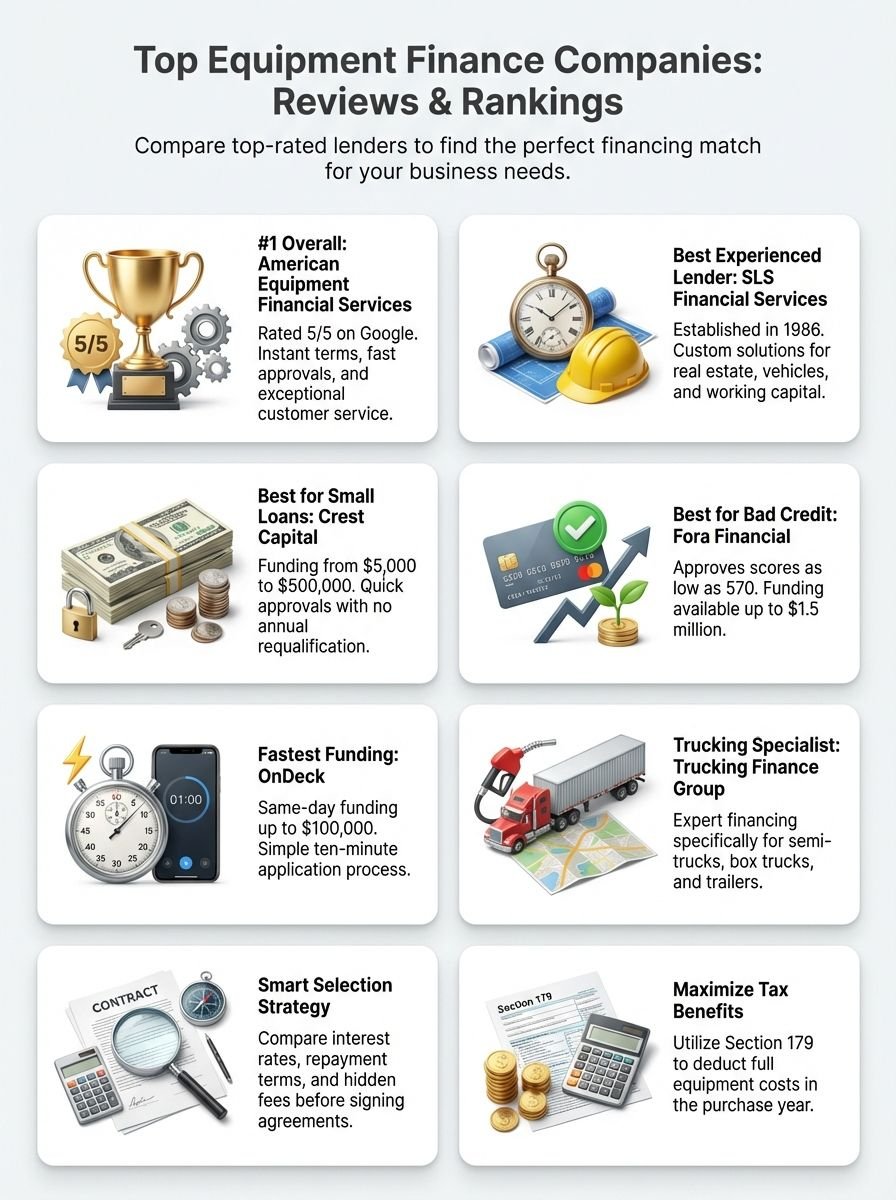
- American Equipment Financial Services (AEFS) is the top-ranked company for equipment financing with a 5/5 Google rating and a 9.87/10 EFR score.
- Crest Capital offers small loans up to $500,000 with no yearly rechecks and fast approvals, making them ideal for smaller purchases.
- Fora Financial provides loans of up to $1.5 million for businesses with bad credit, accepting scores as low as 570.
- OnDeck specializes in same-day funding with loan amounts ranging from $5,000 to $250,000 and terms up to 24 months.
- Leasing fits tools that lose value quickly; financing suits durable goods you need long-term ownership of—choose based on your business needs!
Key Criteria for Evaluating Equipment Finance Companies
Choosing the right lender can save you time, money, and stress. Pay close attention to terms, customer service, and loan flexibility.
Transparency and Customer Experience
Clear communication builds trust. Top equipment financing companies are upfront about terms, fees, and conditions. American Equipment Financial Services shines here with its 5/5 Google Rank and a near-perfect 9.87/10 EFR score.
They offer unmatched customer service that keeps business owners happy and informed throughout the process. In contrast, Trust Capital USA has left clients frustrated with unclear agreements and reports of rude behavior from their leadership team.
Bad transparency creates chaos for customers. Currency Capital has faced accusations of billing for undelivered goods and posting fake reviews online to appear more reliable than they are.
Meanwhile, Ascentium Capital struggles with over 500 negative reviews because of poor response times and hidden costs. A good lender answers questions clearly, keeping you confident about your funding choice every step of the way.
A happy customer talks positively about five things; an unhappy one complains endlessly.
Loan Options, Interest Rates, and Terms
Different lenders offer various loan amounts and terms. Crest Capital provides loans from $5,000 to $500,000 with fast approval and no yearly re-checks. OnDeck specializes in term loans from $5,000 to $250,000 for up to 24 months.
They require a minimum credit score of 625. National Funding offers equipment financing up to $500,000 with repayment periods as long as five years.
Interest rates vary between providers. Bank of America boasts a fixed APR at 6.75%, but you need a credit score of at least 700 for approval. Fora Financial uses a factor rate starting at 1.10 rather than traditional interest rates and requires annual earnings above $240,000 per year to qualify effectively.
Cardiff supports applicants with lower scores like 470 while offering repayment stretches lasting up to six years—ideal for flexibility seekers needing larger windows or manageable payoffs over time!
Top Equipment Finance Companies Ranked
Choosing the right company can feel like finding a needle in a haystack. Here are some top picks to help you cut through the noise and get started.
#1: American Equipment Financial Services
American Equipment Financial Services (AEFS) ranks as the best equipment financing company. It’s known for quick approvals and exceptional service. Their instant-terms pre-qualification system simplifies getting a business loan.
Customers praise their fast turnaround times and smooth process.
They specialize in industry niches, with endorsements from Commercial Truck Trader and Equipment Trader to back them up. AEFS boasts top ratings, including 5/5 on Google and a stunning 9.87/10 EFR Rank.
Call them at **888-475-AEFS** or visit **www.AmericanEFS.com** to explore options that fit your needs quickly!
Professionalism meets speed here.
#2: SLS Financial Services
SLS Financial Services has been around since 1986, providing decades of experience. They focus on helping businesses get financing for real estate, commercial vehicles, and working capital.
Their customer-focused approach makes them a popular pick among small business owners.
Their broad financing solutions cover many asset types, making them flexible for different industries. With high ratings like 9.72/10 on EFR and a perfect 5/5 Google rank, they’ve earned their strong reputation.
Business borrowers also benefit from personalized service customized to their specific needs. Call them at 816-423-8021 or visit www.slsfinancial.com to learn more about the options available.
#3: Crest Capital
Crest Capital, founded in 1989, has been a highly regarded name in equipment financing for over three decades. They focus on small-ticket financing and assist businesses requiring quick approvals.
With a Google rating of 4.9/5 and an excellent EFR score of 9.4/10, they rank high among equipment finance companies.
Their process is efficient, often granting approval within hours. Crest Capital distinguishes itself by approving soft costs and not requiring yearly requalification. Some complaints mention poor communication at times, but their long-standing success demonstrates reliability.
For small or medium-sized businesses needing flexible programs, they provide strong options worth considering without difficulty.
#4: Trucking Finance Group
Trucking Finance Group specializes in financing semi trucks, box trucks, and trailers. They don’t offer many options for heavy equipment financing but are well-respected within the trucking industry.
Their application process is straightforward and saves time.
With a Google rating of 4.81/5 and an EFR score of 9.33/10, they rank high in customer satisfaction. For business owners who need reliable solutions customized for truck purchases, this company stands out as a strong choice.
Call them at 503-305-3336 or visit www.truckingfinance.com for more details on their financing programs.
#5: National Funding
National Funding offers equipment loans and working capital loans for businesses with fair credit. They provide loan amounts up to $500,000 with terms of up to 5 years. Companies need at least 6 months in business and $250,000 in annual sales to qualify.
The company has a BBB Rating of A+ and scores 7.01 out of 10 on the Equipment Finance Review scale. Their website is www.nationalfunding.com, or you can call them at 888-733-2383. This lender works best for businesses looking for flexible financing options without overly strict requirements.
Best Equipment Financing Options by Category
Different businesses have different needs, and so do their equipment financing options. Whether you need quick cash or help with bad credit, there’s something for everyone here.
Best for Small Loan Amounts: Crest Capital
Crest Capital offers loans from $5,000 to $500,000, making it great for smaller equipment purchases. Businesses need at least two years of operational history and must be profitable to qualify.
Bankruptcy on record disqualifies applicants. Approval often comes within hours and includes soft costs, like delivery or installation fees.
This lender has an A+ rating from the Better Business Bureau. Once approved, borrowers don’t need annual re-qualification for their financing loans. While the credit score requirements are not disclosed, Crest Capital works best for small businesses seeking capital equipment financing without unnecessary delays or hurdles.
Best for Same-Day Funding: OnDeck
OnDeck offers fast equipment financing, perfect for businesses needing quick cash. You can get same-day funding up to $100,000 for your business needs. Loans range from $5,000 to $250,000 with terms lasting up to 24 months.
The application takes only about 10 minutes to complete.
To qualify, you need at least a 625 credit score and one year in business. Your company must also earn at least $100,000 annually and have an active business bank account. OnDeck has already funded over $15 billion for small businesses across the United States but does not operate in NV, ND, or SD.
Best for Bad Credit: Fora Financial
Fora Financial helps businesses with less-than-perfect credit. They offer equipment financing up to $1.5 million, making it a solid choice for companies needing large loans. Borrowers only need a minimum credit score of 570 to qualify.
Businesses just six months old can apply too, as long as they bring in at least $240,000 annually or $12,000 monthly.
Their factor rates start at 1.10 and cover term loans and revenue-based options. Fora Financial does not report loan activity to business credit bureaus, so these loans won’t boost your company’s credit score.
This lender is ideal if quick funds matter more than building credit history over time!
Pros and Cons of Equipment Financing
Equipment financing offers lower rates compared to other loans. Borrowers can often secure same-day or next-day funding. The equipment itself serves as collateral, reducing lender risk and approval barriers.
Many loans include tax benefits, like deductions for interest and costs under Section 179. High credit scores may unlock better terms with some lenders offering no down payment options, while others might require up to 20%.
Financing also helps preserve cash flow while allowing businesses to purchase essential equipment.
On the downside, repayment schedules might outlast the equipment’s useful life. This could lead to paying for outdated tools or machines you no longer use. Maintenance is entirely on the borrower’s shoulders; repairs could add unexpected costs over time.
Financed items must also stay operational throughout their term since they’re tied directly to your loan agreement.
Equipment Financing vs. Leasing: Key Differences
Picking between financing and leasing equipment can feel like choosing between renting or owning a home, but each option fits different needs—read on to see which suits your business best!
Including the Differences Between Leasing and Financing Equipment
Leasing equipment lets you use it for a set period, often without needing a down payment. At the end of the lease, you return it unless you buy it through a pre-agreed option. Financing equipment involves buying it outright with borrowed money, usually requiring a down payment.
You own the equipment once payments are complete.
Financed equipment allows for depreciation on your taxes, while leased items don’t qualify. Leasing may include maintenance in its terms; financing places upkeep responsibility on the owner.
Fixed rates are common with financing, but leasing rates may change over time. A lease works well for tools or machines that lose value quickly or need frequent upgrades. Financing fits better with durable goods that last many years.
How to Choose the Right Equipment Finance Company
Finding the best equipment finance company can feel tricky. Follow these steps to make the right choice for your business needs.
- Check the company’s experience in your industry. Some lenders specialize in construction, healthcare, or trucking equipment. Pick a lender who knows the kind of equipment you need.
- Review their loan options and terms carefully. Compare interest rates, repayment periods, and loan amounts. For example, SLS Financial Services offers flexible plans for small businesses.
- Look into their credit score requirements. Most lenders expect scores between 625 and 775. If your credit is low, consider companies like Fora Financial that work with bad credit.
- Assess transparency about fees and conditions. Avoid any lender hiding costs or fine print in contracts.
- Research customer service ratings online. Check BBB reviews; many trusted companies hold an A+ rating.
- Determine how fast they fund loans. If time is critical, focus on lenders offering same-day or next-day funding like OnDeck.
- Confirm if lease options are available too. This allows more flexibility if owning isn’t required for your business model.
- Study annual revenue and business age requirements thoroughly before applying; most ask for $100,000 revenue and at least six months in operation.
- Ask about tax benefits they offer through financing programs like operating leases or loans with deductions.
- Compare specialized programs suited to unique industries or used equipment purchases when needed by your field of work.
Application Process for Equipment Loans
Getting equipment financing is simple if you know the steps and have your paperwork ready—find out how to get started!
Steps to Prequalify and Compare Lenders
You need the right lender to finance your equipment. Prequalifying helps you find the best fit fast. Follow these steps to get started:
- Identify your financing needs. Know the type of equipment and loan amount required. Small business owners often look for loans based on specific gear like restaurant or construction equipment.
- Check eligibility criteria. Review lenders’ requirements for credit scores, annual revenue, and business age. Many companies set a minimum credit score of 620 or higher.
- Gather financial documents. Collect tax returns, balance sheets, and bank statements. These show your business’s financial health.
- Research multiple lenders. Compare their interest rates, terms, fees, and funding times online or through reviews.
- Prequalify with potential lenders. Submit basic info to see what options you qualify for without hurting your credit score.
- Evaluate loan offers carefully. Look at the Annual Percentage Rate (APR), loan terms, penalties for early payments, and upfront costs.
- Consider customer service ratings too. Reliable companies make the process simple while offering clear communication.
- Choose the top offer that fits your needs best! A good choice balances cost, speed of funding, and flexibility.
Follow these steps to move closer to securing that much-needed funding!
Documents Needed for Applications
Getting the right documents ready is crucial to apply for equipment financing. Lenders use these papers to check your eligibility and creditworthiness.
- Personal credit report and business credit history show how well you handle debts. These reports help lenders assess risks.
- Business financial statements, like profit and loss sheets, provide insights into your income and expenses.
- Tax returns, usually for the past 2 years, are often required to verify revenue stability.
- Proof of business age and revenue can include bank statements or sales records showing steady money flow over time.
- Articles of incorporation or formation documents confirm that your business is legally registered with the state or country it operates in.
- Vendor invoices or an equipment purchase plan detail what equipment you intend to buy with the loan funds.
- Proof of equipment insurance ensures the lender that their investment is protected in case of damage or loss after purchase.
- Voided business checks confirm your bank account details for fund transfers and loan repayments later on if approved by lenders.
- A valid photo ID may also be necessary to confirm ownership or management roles in the company applying for loans.
Proper preparation makes applications smoother!
FAQs About Equipment Financing
Get quick answers to common questions about equipment financing, so you can make smart choices for your business.
What credit score is required?
Credit score requirements vary by lender. Some companies work with poor credit, while others need higher scores. Fora Financial accepts borrowers with at least 570. OnDeck requires a minimum of 625, and SBG Funding typically looks for 600 or above but may approve lower in certain situations.
Kapitus stands out with stricter rules, needing a 675 for standard loans and an impressive 775 if your business is under three years old. Meanwhile, Cardiff welcomes scores as low as 470.
National Funding hasn’t disclosed its exact score requirement yet but does offer flexibility based on other factors like time in business and revenue stability. Having better credit often means getting lower rates and better terms in general!
Are equipment loans tax-deductible?
Equipment loans can offer tax benefits. Section 179 allows businesses to deduct the full cost of equipment in the same year it’s financed. Interest paid on these loans may also be tax-deductible, reducing your total expenses further.
To qualify, you must use the equipment primarily for business and follow IRS rules precisely.
Differences exist between financing and leasing regarding deductions. For example, lease payments might count as fully deductible operating costs instead of depreciation over time.
Some lenders even emphasize these potential savings to attract borrowers. Always consult with a tax professional to get clear answers for your situation and prevent any unexpected issues during tax season!
Other Financing Alternatives for Business Equipment
Different financing options, like SBA loans or merchant cash advances, could fit your equipment needs better—explore them all before deciding!
SBA Loans, Business Lines of Credit, and Short-Term Loans
SBA loans offer long repayment terms and large amounts. The SBA 504 loan allows borrowing up to $5.5 million for fixed assets, with up to 10 years for repayment. An SBA 7(a) loan provides up to $5 million, ideal for working capital or buying equipment.
These loans have lower interest rates but require strong credit and strict qualifications.
Business lines of credit provide revolving access to funds. You only pay interest on the amount you use, making it flexible for ongoing needs. Short-term loans are quicker solutions, often repaid in 1–2 years.
They work best for smaller purchases or emergencies but can cost more due to higher interest rates. SBG Funding offers same-day funding with a minimum credit score of 600, while some banks like Bank of America may require at least a 700 score and six months in business.
Conclusion
Choosing the right equipment finance company can change your business. The top companies offer different strengths, from fast funding to support for bad credit. Compare options carefully, and think about what works best for your needs.
With the right partner, getting new equipment becomes simple and stress-free!
For a deeper understanding of how equipment leasing differs from financing, read our detailed guide here.
FAQs
1. What are equipment financing options for small businesses?
Small businesses can explore equipment leasing companies, finance leases, or lines of credit to purchase the equipment they need without upfront costs.
2. How can I qualify for an equipment financing loan?
To qualify for an equipment financing loan, you’ll typically need a minimum credit score requirement and proof that your business generates enough income to cover payments.
3. Can I get equipment financing with bad credit?
Yes, some lenders offer specialized options like best bad credit loans or alternative types of financing tailored for those with poor credit histories.
4. What is the difference between leasing and purchasing equipment?
Leasing allows you to rent pieces of equipment for a set period and return them later, while purchasing means owning the new piece of equipment outright after paying its full cost.
5. Are there tax benefits when using these services?
Yes, many business owners enjoy tax deductions on leased or financed items depending on their financial institution’s policies and local regulations.
6. How do I choose the best company for my needs?
Look at factors like reviews of top picks, terms offered by creditors, total cost of purchasing or renting the item in question, and whether they provide flexible solutions such as restaurant-specific leases or health care-related tools.
