
Are you curious about how much do equipment finance brokers make? These brokers play a big role in helping businesses secure loans for costly equipment. With commissions that can reach up to 15%, their income potential is huge.
Stick around, and you’ll learn how they earn and what drives their success.
Key Takeaways
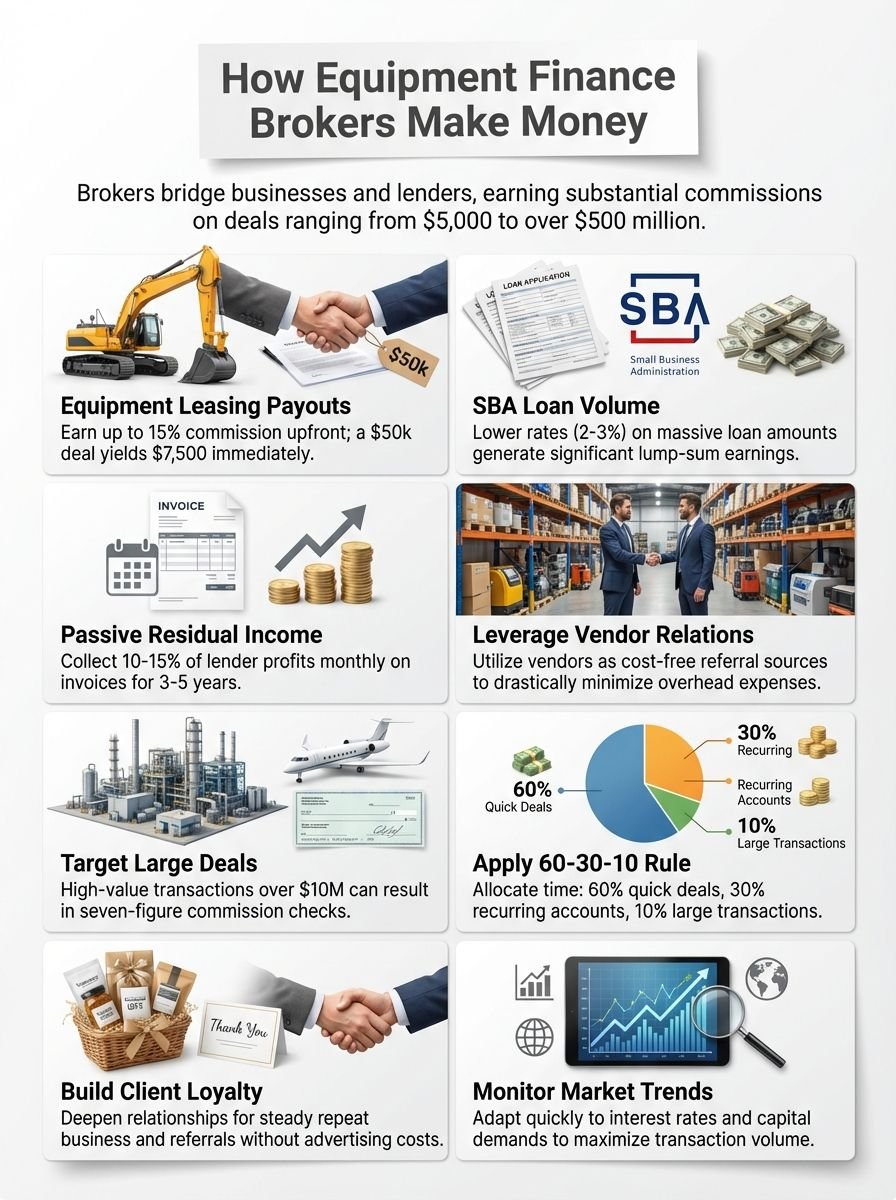
- Equipment finance brokers earn commissions based on loan type, size, and structure. Rates range from up to 15% for equipment leasing to 2-3% for SBA loans.
- Residual income is a key benefit. Brokers can earn 10-15% of lender profits from invoices over 3-5 years. For example, they profit monthly if lenders advance $85,000 on a $100,000 invoice.
- Bigger deals mean higher payouts. A broker can make $30,000 on a $1 million SBA loan or even seven figures on deals worth over $10 million.
- Success depends on factors like experience, deal volume per month, and maintaining residual accounts that provide steady cash flow.
- Managing time well helps maximize earnings with the “60% quick transactions, 30% recurring accounts, and 10% large deals” strategy.
Understanding the Role of Equipment Finance Brokers in Commercial Loan Finance
Equipment finance brokers act as the bridge between businesses and lenders. They help companies secure loans for equipment, machinery, or vehicles by connecting them with suitable financing options.
These brokers often manage deals ranging from $5,000 to over $500 million. Their efforts save companies time by simplifying the loan application process and handling key negotiations.
Building strong vendor relationships is a big part of their work. A good broker taps into these vendors to find steady customer referrals without extra costs. This setup works like a bonus sales team for brokers while maintaining low overhead expenses.
Brokers also handle one-time fees and accounts that bring ongoing residual income, ensuring regular earnings after closing large deals quickly.
“One well-managed deal can lead to multiple opportunities down the road.”
How Broker Commissions Are Structured in Equipment Financing
Brokers play a key role in connecting lenders and clients. Their earnings are based on structured commissions, often determined by loan type and size. Let’s break it down:
| Loan Type | Commission Percentage | Example Loan Amount | Earnings Per Deal |
|---|---|---|---|
| Equipment Leasing | Up to 15% | $50,000 | $7,500 |
| SBA Loan | 2-3% | $1,000,000 | $30,000 |
| Residual Income on Invoices | 10-15% of Lender’s Profits | $100,000 Invoice ($85,000 Advanced) | Ongoing for 3-5 Years |
Some transactions, like leasing, offer high upfront payouts. For instance, closing a $50,000 deal with a 15% rate brings $7,500. SBA loans usually offer 2-3%, but because the loan size is larger, brokers earn significant sums. A $1,000,000 deal at 3% means an impressive $30,000 payday.
Residual income is another perk. Brokers receive a share of profits from every invoice as long as the client stays. Let’s say a lender advances $85,000 on a $100,000 invoice. Brokers earn 10-15% of the lender’s profit monthly for years, often between 3 and 5 years. These passive streams add up.
Structured commissions like these allow brokers to control their income. Each successful deal brings immediate gains, even with just a few closings per month.https://www.youtube.com/watch?v=iTgLV7ydAw0
Factors Influencing Earnings for Equipment Finance Brokers
Earnings for equipment finance brokers depend on many factors. Success comes from effort, smart work, and handling transactions wisely.
- Type of Loan Products
Different loan products pay different commissions. Loans for working capital or equipment financing usually have smaller payouts compared to larger deals like commercial real estate loans or factoring (accounts receivable). - Average Deal Size
Larger deals mean bigger commissions. For example, significant transactions worth over $10 million can bring in seven-figure earnings, such as a broker earning $1 million from a $115 million deal in eight months. - Number of Deals Closed per Month
Consistently closing more deals boosts income. Brokers achieving high-volume quotas often see substantial increases in annual compensation compared to those with fewer deals. - Years of Experience in the Industry
Experienced brokers get better at managing intricate transactions, developing repeat clients, and targeting the right opportunities, increasing their earnings potential over time. - Residual Income Accounts
Managing accounts with steady cash flow boosts monthly earnings. A broker working with clients generating $2 million annually can earn between $2,300 to $2,700 each month just from residuals. - Time Management and Strategy
Following the 60-30-10 rule helps maximize income: 60% on quick transactions, 30% on recurring accounts, and 10% on large deals ensures balanced efforts across all earning opportunities. - Industry Trends and Demand
High interest in certain loan types or capital needs creates new earning opportunities. Brokers offering competitive solutions stay ahead and earn more consistently. - Networking and Repeat Clients
Building strong client relationships brings repeat business and referrals that help expand a broker’s reach without heavy advertising costs. - Commission Structure by Companies or Banks
Some companies offer higher commission rates than traditional banks or independent managers; this impacts how much brokers take home per deal closed. - Economic Factors and Market Conditions
Changes in interest rates or funding limits affect transaction volume directly; these variables can increase or reduce overall earnings depending on timing and market conditions.
Conclusion
Being an equipment finance broker can be a goldmine for the right person. Commissions, bonuses, and residual income stack up fast with effort and smart planning. Balance your time on small deals, big transactions, and repeat clients to keep the money flowing.
This career is about building relationships, closing deals, and staying motivated. If you put in the work, the sky’s the limit!
For a deeper understanding of how equipment financing works, visit our detailed guide here.
FAQs
1. How do loan brokers earn money in commercial loan finance?
Loan brokers earn by charging commissions and bonuses on the deals they close. They also generate income through factoring, which is common in the finance industry.
2. What is the earning potential for equipment finance brokers?
Equipment finance brokers can earn a lucrative salary, with some making over $200k per year if they consistently close high-value deals each month.
3. Why is this field considered an opportunity to earn well?
The finance industry offers opportunities to sell loans and insurance products while earning gross commissions on every deal completed, making it a profitable career path.
4. Do you need many years of experience to succeed as a loan broker?
While experience helps refine your approach and analytics skills, even new brokers can start generating income quickly by focusing on closing deals and building relationships with companies.
5. How many deals does it take to make good money as a broker?
It depends on the size of each deal, but closing just a few solid deals per month can lead to substantial earnings from commissions alone.
