
Getting the right equipment for your business can feel tricky. One big question is, “How long can you finance equipment?” The answer depends on factors like loan type, equipment condition, and payment terms.
Stick around to learn what works best for your business needs!
Key Takeaways
- Equipment loans last 1–10 years, with newer items typically financed for 3–7 years. Used equipment gets shorter terms, about 3–4 years.
- Loans often offer longer durations than leases. Leases usually run 2–5 years but work well for short-term needs or rapidly depreciating gear.
- Balloon payments and deferred options allow flexibility in schedules but increase risks if future revenue falls short.
- Section 179 lets businesses deduct up to $1,160,000 on qualifying equipment in 2023. Bonus depreciation adds more upfront savings at 80%.
- Startups can access financing via SBA loans or online lenders but may face higher interest rates or stricter terms from traditional banks.
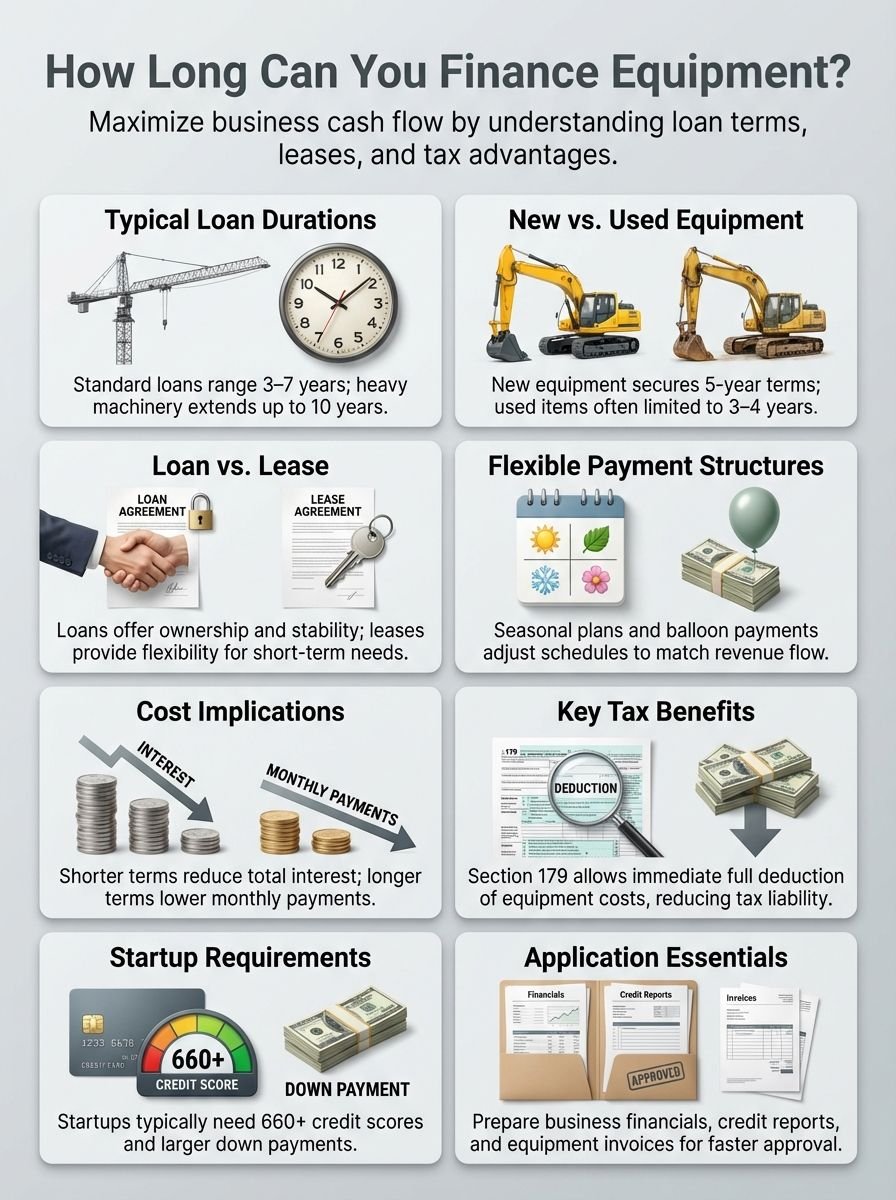
Typical Equipment Financing Terms
Equipment financing terms usually fall between 1 and 10 years. Most business equipment loans for newer items, like machines or vehicles, range from 3 to 7 years. Older equipment often gets shorter terms, typically around 3 to 5 years.
Balloon payments are an option some lenders offer at the loan’s end. For example, a lender might allow up to half of the loan amount as a lump sum payment later. Some loans match the repayment length with how long the asset will last, such as financing heavy machinery over its expected lifespan of 15 years.
Factors That Influence Loan or Lease Duration
The length of financing often depends on the equipment’s purpose and lifespan. Some industries might need shorter terms, while others stretch them longer for heavy gear.
Equipment type (new vs. used)
New equipment often qualifies for financing terms up to 5 years. Lenders see it as less risky since it has a longer lifespan and higher value. This makes monthly payments more manageable for business owners.
It is ideal for businesses looking to use the equipment long-term without frequent repairs.
Used equipment is cheaper upfront but may have shorter loan terms, usually 3-4 years. Its reduced lifespan and faster depreciation make lenders cautious. Some banks might expand terms depending on its condition or collateral quality, but that’s not always common.
Consulting brokers can help secure better options if you choose pre-owned machinery over newer models.
Industry-specific term variations
Loan terms often depend on your industry and the equipment you need. Construction companies may get up to 10 years for financing high-value machinery like excavators. Medical devices or agricultural tools often qualify for medium-length terms, such as 5-7 years.
Lenders group equipment into categories like primary (trucks, earthmovers), secondary (generators, compressors), and tertiary (fitness, solar panels). Commercial vehicle loans typically last 1–7 years since they match usage cycles in industries like transportation or agriculture.
Some government programs, such as SBA loans, offer longer terms specifically for manufacturing or real estate-related businesses.
Loan vs. Lease: Which Offers Longer Financing Options?
Sometimes, it boils down to duration. For equipment financing, understanding which option offers more time can save headaches later. Here’s a breakdown in a no-nonsense comparison table:
| Feature | Equipment Loan | Equipment Lease |
|---|---|---|
| Typical Duration | Up to 10 years (depending on asset type and lender) | 2 to 5 years in most cases |
| Ownership | You own the equipment after payoff | Pay for use only, unless you buy it at the lease end |
| Recommended For | Long-lasting assets, like heavy machinery or vehicles | Short-term usage or equipment prone to rapid wear |
| Collateral Requirement | Yes, the equipment secures the loan | No, as the lessor typically owns it |
| Flexibility in Term Length | More customizable depending on the lender and asset type | Less adjustable; terms are usually set by lessors |
| Costs Over Time | Likely lower due to fixed interest and ownership | Higher if the lease is renewed multiple times |
| Key Example | A construction company financing a $100,000 bulldozer over 7 years | A tech company leasing computers that depreciate rapidly |
Loans often outlast leases. They cater to those investing in durable tools and machinery. Leasing works better in industries needing frequent upgrades. Each option serves its own niche but with distinct timelines.https://www.youtube.com/watch?v=bSy_ZHvGrgw
Seasonal and Flexible Payment Structures
Some payment plans let you adjust based on busy or slow seasons, making it easier to manage cash flow.
Balloon payments and deferred payment options
Balloon payments and deferred options can make equipment financing flexible. These choices adjust payment schedules to fit business needs.
- Balloon payments allow lower monthly costs during the loan term. At the end, a lump sum, often up to 50% of the total loan, is due.
- Companies can handle this balloon in three ways: pay it off in full, refinance the amount, or sell the equipment to cover costs.
- Deferred payments let borrowers delay starting their loan payments for several months. This can help businesses manage cash flow early on.
- Lenders offering deferred options often gear these plans toward startups or seasonal businesses expecting higher revenue later.
- Balloon setups work well for long-lifespan equipment or stable industries that expect steady growth in income over time.
- Deferred start options ease new project launches by reducing financial pressure until operations are running smoothly.
- Not all lenders provide these features. Borrowers should compare programs before deciding.
- Both structures hold risks if future revenue doesn’t meet expectations. Planning ahead can reduce surprises down the road.
- These options suit small business owners who need flexibility but must weigh final costs carefully before committing.
- Choosing balloon or deferred terms depends on your credit score, equipment value, and industry type—calculate wisely before signing anything!
How Loan Length Impacts Interest Rates and Total Costs
Shorter loans often have lower interest rates. Lenders face less risk with a shorter repayment period, so they charge reduced interest. For example, a three-year loan for equipment might have a lower rate compared to a seven-year loan.
Businesses save on total costs with shorter terms because there’s less time for interest to accumulate. On the other hand, longer loans spread payments out and lower monthly bills but increase overall spending due to higher lifetime interest.
Long-term financing can cost more than expected if fees are added in too. Origination fees and late penalties can add up over time. Loans with balloon payments may seem appealing since they lower initial monthly costs but require more payment over years of amortization.
A $50,000 equipment loan stretched across 10 years could add thousands extra in interest alone versus paying it off in five years. Balancing upfront affordability against long-term expenses is crucial for any business aiming to manage its budget effectively.
Tax Benefits of Equipment Financing
Using equipment financing might save your business money during tax season, thanks to deductions and depreciation—check how it fits your needs!
Section 179 deduction and bonus depreciation
Section 179 and bonus depreciation can save businesses money. These tax perks help small business owners reduce costs when they purchase equipment.
- Section 179 lets businesses deduct the full cost of qualifying equipment immediately instead of spreading it over years.
- In 2023, the limit for Section 179 deductions is $1,160,000 and applies to both new and used equipment.
- Bonus depreciation allows additional savings by letting businesses deduct a percentage of costs upfront. It currently covers 80% for eligible purchases in 2023 but will drop in the future if no law changes occur.
- Both options work for items like heavy machinery, vehicles (within limits), and office tech such as computers or software.
- Leases with purchase agreements can qualify for these deductions, giving flexibility to how you finance equipment.
- Startups benefit because these incentives reduce capital strain during business growth phases.
- Tax rules often change; check updates yearly or consult experts before filing your taxes.
- Using Section 179 may lower effective interest rates since the upfront savings can pay off loans faster.
- Bonus depreciation applies to used machinery too, making it great for smaller budgets or older tech needs.
- Always confirm eligibility based on factors like time in business or type of equipment purchased.
These tools are vital to smart financing strategies!
Application Process for Equipment Financing
Getting equipment financing starts with gathering key details about your business and finances. Lenders want to see strong credit, clear plans, and the right paperwork ready to go.
Documents needed and approval timelines
You’ll need a few key items to apply for equipment financing. These include your business financials, credit report, and an invoice for the equipment. A valid ID and a solid business plan are often required too.
Most lenders ask for proof of down payment, usually 10–20% of the cost. If you’re applying through SBA loan programs like the SBA 504 Loan, expect to provide extensive personal and business financial history.
Approval times vary by lender. Online lenders might approve applications in just one day. Banks or credit unions could take several weeks instead. Details about the equipment, like its age and serial numbers, may also be necessary.
Some industries require specific documents for eligibility checks too. Pre-approval can speed up this process with certain online options available upfront!
Can Startups Access Long-Term Equipment Financing?
Startups can obtain long-term equipment financing, but it’s not straightforward. Traditional banks and credit unions often have strict rules. A minimum credit score of 660 is frequently required, along with proof of steady revenue or time in business.
Startups might need to provide personal guarantees or larger down payments.
Online lenders offer quicker approvals and more flexible terms but charge higher interest rates. Some equipment dealers collaborate with lenders to assist startups in financing at the point of sale.
SBA loans are another option, though they usually take longer for approval and involve detailed paperwork. Working with brokers can save time by matching new businesses with suitable financing options customized to their needs.
Online Tools to Calculate Financing Terms
Online tools simplify equipment financing. Many lenders, like American Express, provide calculators to estimate loan terms. These tools can show repayment amounts for loans ranging from $2,000 to $250,000.
You can also see interest rates and fees based on different term lengths such as 6, 12, or 24 months.
Some platforms include pre-qualification features without harming your credit score. Early payoff calculators help you see possible savings by settling a loan early. Other options account for balloon payments or deferred schedules.
Using these tools speeds up planning and provides clear costs before applying for business loans or leases.
Reviews on Capital Equipment Financing
Capital equipment financing can help businesses secure heavy equipment or technology without paying upfront. Many find it useful for managing working capital while still acquiring necessary tools.
For instance, American Express offers business lines of credit from $2,000 to $250,000. These loans often require business assets as collateral and a personal guarantee.
Loan terms vary by sector. Installment fees might range from 3% over six months to as high as 27% on longer plans like 18 months. A single repayment loan may charge around 0.95%-1.80% in one month or up to 6.05% for three months’ duration.
Early repayments also remove unearned future costs, helping borrowers save money when finances allow faster payoffs.
Common Fees and Costs in Equipment Financing
Borrowing money to get the equipment you need has costs. Lenders often charge origination fees, which may range from 1%–5% of the loan amount. These fees cover processing and paperwork for your equipment loan or lease.
Late payments can lead to extra charges, adding pressure if cash flow gets tight.
Many loans require down payments between 10% and 20%. Leasing might include monthly service fees or purchase options at the end of the term. Balloon payment structures could increase costs later on, so careful planning is key.
Interest rates differ based on credit history; better scores mean lower rates over time.
Tips for Choosing the Right Financing Option
Consider the equipment’s lifespan before deciding on financing. A loan that matches the life of the equipment ensures you get full value without overpaying. For a short-lived piece of machinery, leasing may work better than buying outright.
Compare interest rates and fees from different lenders. Government programs like SBA 7(a) loans might offer longer terms or lower costs for small businesses. Check your business cash flow to pick monthly payments you can handle comfortably.
In some cases, working with brokers helps secure financing for older or specialized equipment that banks may not cover.
Conclusion
Finding the right equipment financing option can shape your business’s success. Whether through loans, leases, or other tools, each choice offers benefits and trade-offs. Think about costs, terms, and how it fits your goals before deciding.
The right plan keeps cash flow steady while helping you get the gear you need. Plan smartly today for a stronger tomorrow!
FAQs
1. How long can you finance equipment?
The length of time depends on the type of equipment, its cost, and the financing option you choose. Most terms range from 12 months to 10 years based on the lifespan of the equipment being financed.
2. What are common options for financing business equipment?
You can get an equipment loan, lease, or use a line of credit. Each option has different benefits depending on whether you want to purchase new or used equipment outright or return it at the end of your term.
3. What factors affect how long I can finance my equipment?
Factors include the kind of equipment, its wear and tear over time, your business credit score, and collateral requirements set by creditors or lenders.
4. Can small businesses benefit from leasing instead of buying?
Yes! Leasing allows many business owners to acquire necessary equipment without needing a large upfront investment while spreading payments over time.
5. Are there specific requirements for getting an equipment loan?
Yes; lenders typically look at your business credit score, type of business structure (like LLCs), collateral availability, and financial details like bank account history or Social Security number in the United States.
6. Is refinancing an option if I already financed my equipment?
Absolutely! Refinancing lets you adjust payment terms for better rates or lower payments based on current debt levels and market conditions related to your secured loan agreement.
