
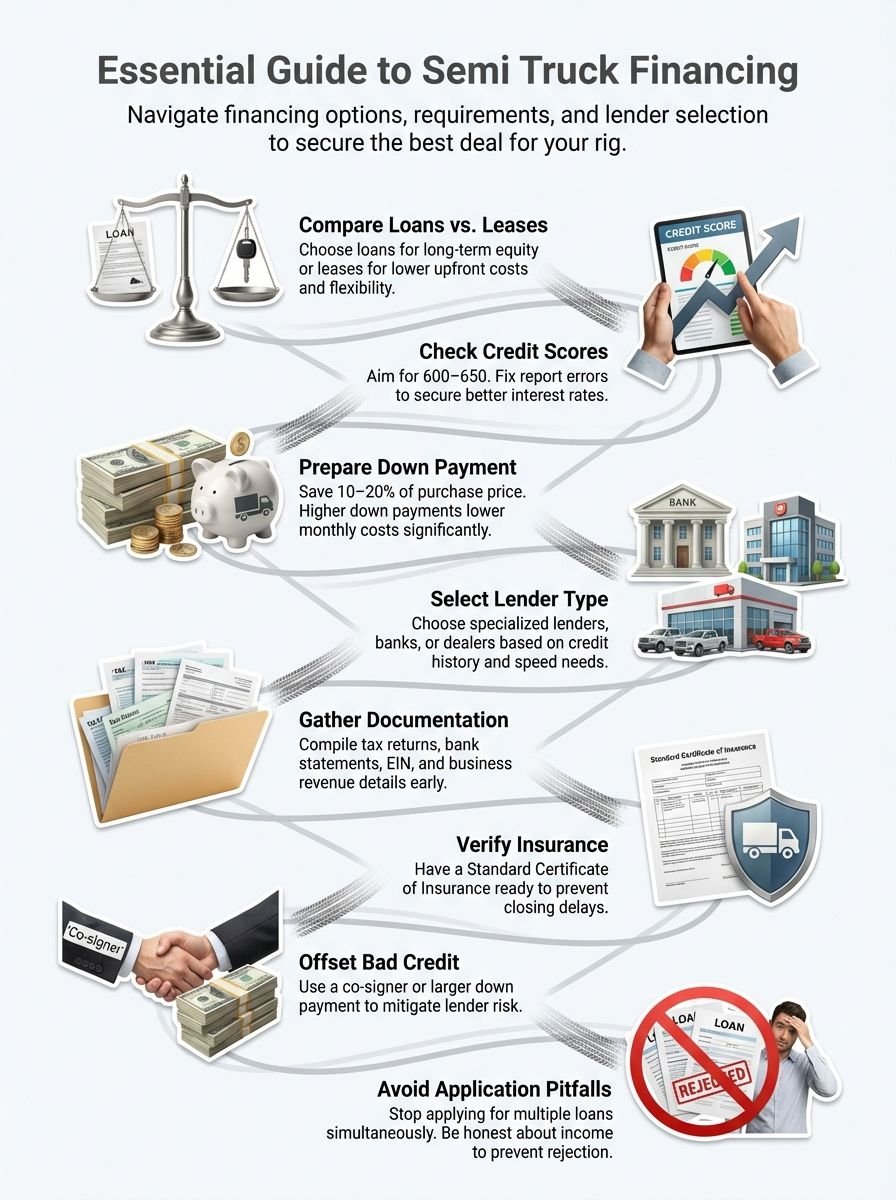
Understanding Your Financing Options
Choosing the right financing option for your semi-truck can save you money and stress, so learn the different routes before making a move!
Loans vs. Leases: Which is Best for You?
Loans and leases serve different purposes depending on your needs, budget, and long-term goals. Let’s break it down to help you figure out what works best for your semi-truck purchase.
| Factor | Loans | Leases |
|---|---|---|
| Ownership | You own the truck after paying off the loan. Builds equity in the vehicle. | You don’t own the truck. It must be returned or purchased at the end of the lease. |
| Upfront Cost | Usually requires a down payment (10%–20% of the truck cost). | Lower upfront costs, often no down payment required. |
| Monthly Payments | Higher monthly payments because you’re working toward ownership. | Lower monthly payments as you’re only paying to use the truck. |
| Loan/Lease Term | Typically lasts 12–60 months, depending on the lender. | More flexible terms, shorter in many cases. |
| Maintenance | All maintenance costs are your responsibility after purchase. | Some leases include maintenance and service packages to ease costs. |
| Credit Requirements | Often stricter. A solid credit score boosts approval odds. | Generally easier to qualify for, even with limited credit. |
| Flexibility | Not ideal if you need to upgrade vehicles frequently. | Perfect if you want to switch to a newer model every few years. |
| Long-Term Costs | More cost-effective over time if you plan to keep the truck long-term. | May cost more over the years if you continuously lease. |
| Collateral | The truck serves as collateral. Nonpayment risks repossession. | Asset isn’t yours, so repossession doesn’t apply. |
Before deciding, weigh your financial stability, credit score, and long-term plans. Both options have their strengths, but your choice should align with your business objectives.
Exploring Rent-to-Own and Dealer Financing
Rent-to-own programs work well for buyers with low credit or limited funds. You pay monthly and own the truck after completing payments. These programs often have higher rates than traditional loans, but they accept lower credit scores.
For example, some dealerships don’t require perfect financial history to approve your deal. This option can help first-time buyers secure a truck while building business income.
Dealer financing offers flexible terms and perks like service packages or trade-ins as part of your payment plan. Many dealers, like Birmingham Freightliner & Western Star, provide options for both new and used semi-trucks.
A larger down payment may reduce interest rates on these plans, which vary by dealer policies.
Sometimes the right dealership can be the key to driving home your first truck.
Key Requirements for a Semi-Truck Loan
Lenders want to see solid credit, steady income, and some cash upfront—are you ready to meet their checklist?
Credit Score and Financial History
A credit score of 600–650 is often needed for first-time buyers seeking semi truck financing. Scores below this range may result in higher interest rates or larger down payments.
Borrowers with limited financial history might need a co-signer or co-borrower to boost their chances.
Paying bills on time, reducing debt, and fixing errors on your credit report can improve your score. Some lenders, like Triton Capital, accept scores as low as 550–575 but may set stricter terms.
Your income, debt ratio, and the value of the truck also play key roles in approval decisions.
Down Payment Expectations
Down payments often range from 10% to 20% of the truck’s price. For a $100,000 semi-truck, this means you may need $10,000 to $20,000 upfront. Buyers with poor credit or limited experience could face higher percentages.
Selfreliance FCU requires at least 15% for new vehicles and 20% for used ones.
Larger down payments lower monthly costs and total interest over time. Saving consistently helps reach your goal faster. You can also explore trade-ins or grants as extra funding sources.
Some lenders offer $0 down options if you have strong credit scores or a solid financial history.
A bigger down payment today can save thousands tomorrow.
Top Lenders for Semi-Truck Loans
Finding the right lender can make or break your truck-buying journey, so explore options that fit your needs and offer fair terms.
Specialized Lenders, Banks, and Dealer Options
Finding the right lender is key to buying a semi-truck. Each option offers different benefits and terms.
- Specialized lenders focus on truck financing. They know this market well and offer flexible terms. Many cater to owner-operators or fleet owners, with options for new or used trucks.
- Traditional banks have competitive rates and longer payment terms. However, their approval process is slow. A strong credit score and financial history are often required.
- SBA lenders provide low-interest loans with long-term repayment plans. These work best if your business has been running for a few years and you have solid credit.
- Online lenders give fast funding and easier approvals, but rates are higher. They suit buyers with bad credit or little experience in trucking.
- Dealers often offer in-house financing options like Birmingham Freightliner & Western Star. These dealers may lower down payment requirements or help structure better loan offers for buyers.
Steps to Apply for a Loan
Start by gathering your financial documents and truck details. Know what lenders want, so you’re not caught flat-footed during the process.
Preparing Documents and Meeting Application Criteria
Getting a semi-truck loan starts with proper preparation. You’ll need to gather documents and meet lender requirements. Here’s what to know:
- Provide your company details, including annual revenue, years in business, and business type. Lenders look at this to understand your operations.
- Submit your personal credit score and financial history. A higher credit score increases your chances for better rates.
- Include three months of personal and business bank statements for each guarantor. This helps show cash flow stability.
- Prepare a list of current trucks or trailers owned, along with their loans and monthly payments if any exist.
- Supply your truck’s details, such as its type, age, mileage, and seller information. The lender may prefer newer models with lower mileage.
- For private purchases, confirm the title is clean without liens attached to it.
- Present an EIN (Employer Identification Number) or SSN (Social Security Number) for identity verification during the process.
- Have a Standard Certificate of Insurance ready by loan closing time as lenders require proof of coverage.
- Notify the lender about any changes regarding your application or business during the approval period to avoid delays or rejections.
- Act within 30 days after receiving credit decisions or APR offers since they expire quickly after being issued.
Preparation builds confidence with lenders, making it easier to secure financing solutions that fit your needs!
Tips for First-Time Buyers
Buying your first semi truck can feel like stepping into uncharted waters. Stay sharp, ask questions, and tackle each step with focus—it’s a marathon, not a sprint!
Avoiding Common Pitfalls and Strengthening Your Application
Getting a semi-truck loan can feel tricky, but good planning makes it easier. Avoid common mistakes to boost your chances of approval.
- Check your credit report for errors before applying. Mistakes on your report can cost you a loan.
- Pay down existing debts to lower your debt-to-income ratio. Lenders like borrowers who manage their finances well.
- Skip applying for multiple loans at once. This will ding your credit score and make lenders cautious.
- Save for a larger down payment if possible. A higher upfront payment may get you better rates and terms.
- Gather all required documents early, such as proof of income and tax returns. Missing paperwork delays the process or leads to rejection.
- Research lender-specific requirements like time-in-business rules or credit score minimums. Every lender has its own expectations.
- Be honest about your business experience with lenders. Some offer options for new owner-operators or first-time buyers.
- Work on improving your credit score if it’s below 650 before applying for financing companies’ offers.
- Don’t underestimate truck ownership costs, like maintenance or insurance expenses, when budgeting.
- Consider finding a co-signer if you lack strong financial history or experience in the trucking industry.
- Ask questions about loan terms, including loan-to-value ratio limits and prepayment penalties, so there are no surprises later.
- Avoid lying about income or financial status in your application process; this often leads to application denial or fraud issues later on!
Financing for Bad Credit or Limited Experience
Bad credit or being new doesn’t mean no truck loan; there are ways to strengthen your case and still get financed—read on to learn how.
Strategies for Approval with Lower Credit Scores
Boost your chances by increasing your down payment. A larger upfront amount reduces the lender’s risk, even with a low credit score. Many lenders offer semi-truck financing options customized for those with less-than-perfect credit.
Apply with a co-signer to strengthen your application. Lenders may also approve loans faster if you accept higher interest rates or shorter terms. Explore dealer financing and rent-to-own programs too; they often have easier requirements compared to traditional bank loans.
Enhancing Your Loan Application Skills
Organize your documents early. Collect bank statements, tax returns, and a clear bill of sale for the truck. Lenders will also need details about the truck you plan to purchase. Share essential facts such as its model, age, mileage, and general condition.
Monitor your credit score regularly. Correct any errors or negative marks prior to applying. Demonstrate your commitment by providing a solid financial record with no gaps in income history.
If other trucks in your fleet have loans, include them along with monthly payments. This reflects your openness about past debts while preparing to manage new ones responsibly!
Conclusion: Securing the Right Loan for Your Semi Truck
Getting a loan for a semi truck doesn’t have to feel like climbing a steep hill. Understand your options, know what lenders want, and prepare strong documents. With the right plan, you can secure the best loan for your needs.
Take it one step at a time—you’ll be on the road sooner than you think!
FAQs
1. What is a commercial truck loan?
A commercial truck loan helps buyers purchase semi-trailer trucks or other commercial vehicles by providing financing options tailored to business needs.
2. How can first-time buyers get financed for a semi-truck?
First-time buyers should have a solid credit history, prepare a detailed business plan, and work with lenders that offer flexible financing terms based on their time in business.
3. What are the best financing options for purchasing commercial trucks?
The best options vary by lender but may include traditional financing, fleet financing, equipment loans, or leasing agreements depending on your credit score and type of truck you need.
4. Does my credit score affect the loan amount I qualify for?
Yes, your credit score plays a big role. A higher score often leads to better rates and larger loan amounts; subprime lending may be an option if your score is lower.
5. Can new businesses apply for commercial truck loans?
New businesses can apply but might face stricter requirements like higher down payments or shorter repayment terms due to limited time in business or lack of established credit history.
6. What happens if I default on the loan?
If you default on the loan, creditors may repossess the vehicle used as collateral; this could harm both your personal and business credit scores significantly.
