
Struggling to get equipment for your business because of bad credit? You’re not alone; many business owners face this obstacle. Luckily, equipment financing with bad credit is an option that can help you move forward.
Stick around, we’ve got all the details to make it easier for you!
Key Takeaways
- Businesses with bad credit can still get equipment financing. Some lenders accept scores as low as 500 but may charge higher interest rates.
- Alternative lenders like Crestmont Capital and 1st Commercial Credit offer fast approvals, flexible plans, and funding up to $10-$15 million.
- Options like no-credit-check loans rely on cash flow or equipment collateral instead of credit history. Higher interest rates or down payments may apply.
- Making timely payments on financed equipment helps rebuild credit and improve future loan terms. Using a cosigner with good credit strengthens applications too.
- Leasing often requires lower upfront costs than financing and offers upgrade options, while financing leads to full ownership of the equipment over time.
Understanding Equipment Financing with Bad Credit
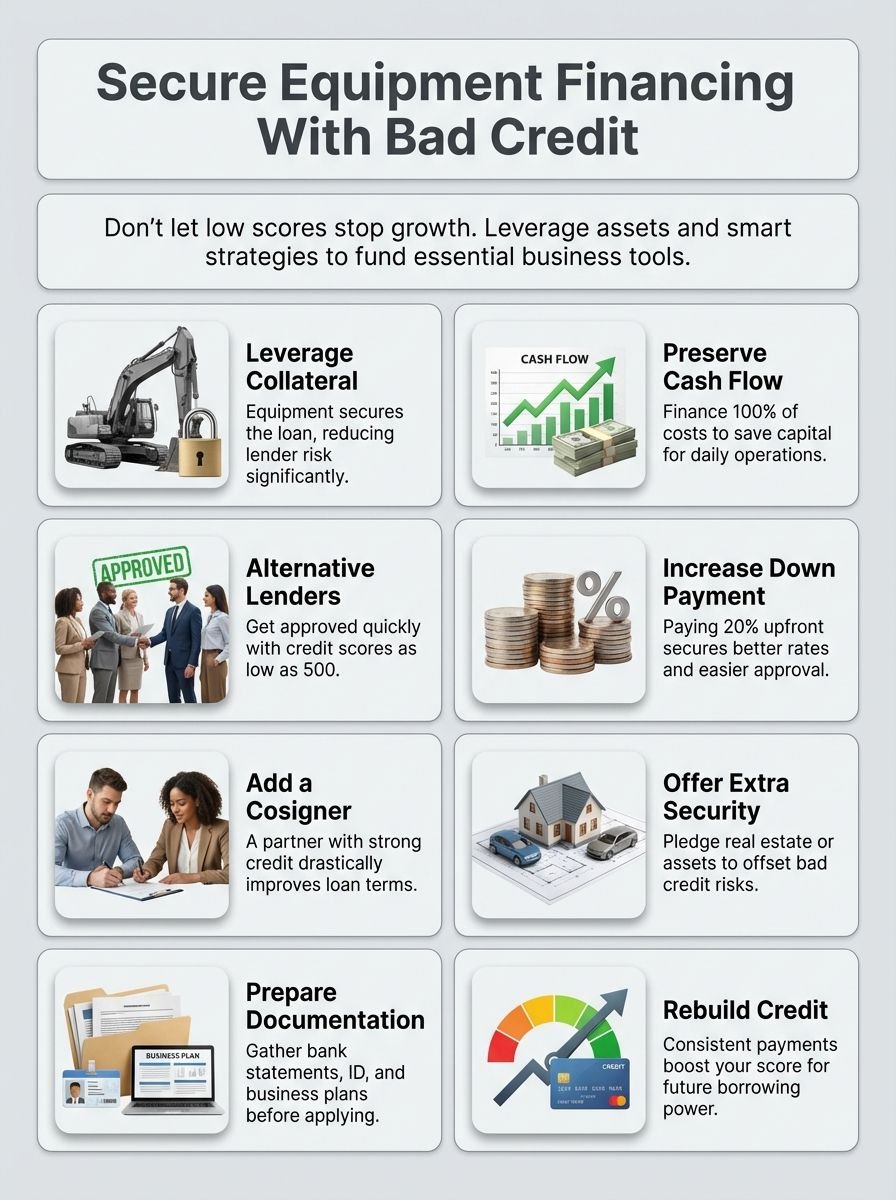
Bad credit doesn’t mean equipment financing is out of reach. Many lenders consider the equipment itself as collateral, reducing risk for them. This gives businesses with poor credit a chance to secure funding.
Some options are available even with credit scores as low as 500, though interest rates might be higher.
Loan amounts vary widely. Simple applications can unlock up to $500,000, while detailed documentation may qualify businesses for up to $10 million in funding. Applicants might need personal guarantees or more collateral due to their credit history.
Lenders like Crestmont Capital and 1st Commercial Credit specialize in bad credit loans for industries of all types, making financing possible where others may hesitate.
Key Benefits of Equipment Financing for Bad Credit
Equipment financing helps get the tools you need without draining your bank account upfront. Plus, it gives a chance to prove reliability and make strides in improving credit over time.
Access to Essential Equipment Without Large Upfront Costs
Small businesses often need expensive tools to grow. Buying machines, vehicles, or technology outright can drain cash flow. Equipment financing solves this problem by covering 100% of costs upfront.
Crestmont Capital even includes consumables and installation fees in their loans.
No large down payment is required with many programs. This means you can keep your money for other expenses like payroll or marketing. Flexible plans let you pay monthly, quarterly, or seasonally based on your needs.
With approval within hours and funding within days, getting the equipment your business needs has never been easier!
Opportunities to Build or Improve Credit Scores
Making timely payments on an equipment loan can help rebuild credit. Each payment shows lenders you’re reliable and capable of managing debt. This history reflects positively on your credit report and may boost both personal and business scores.
Using a cosigner with strong credit also opens doors for better financing terms. Over time, successfully paying off the financed equipment builds trust with creditors. This can improve your chances of securing future loans at lower rates or higher amounts.
Best Loan Options for Bad Credit Equipment Financing
Finding the right loan with bad credit isn’t a walk in the park, but it’s doable. Some lenders focus on helping businesses secure equipment, even if money is tight or credit scores are low.
Traditional Lenders vs. Alternative Lenders
Traditional lenders and alternative lenders offer distinct paths for equipment financing, especially if your credit score is less than stellar. Here’s a side-by-side breakdown of how they differ, so you can weigh your options quickly.
| Criteria | Traditional Lenders | Alternative Lenders |
|---|---|---|
| Credit Score Requirements | Typically 650 or higher | Accept scores as low as 500 |
| Approval Speed | May take several weeks | Quotes and approvals in minutes |
| Documentation Needed | Extensive (financial statements, tax records) | Minimal (basic business and personal info) |
| Down Payment | Often required, up to 20% | Some offer no upfront costs |
| Loan Flexibility | Limited repayment options | Monthly, quarterly, or seasonal plans |
| Loan Sizes | Larger sums for big purchases | Microloans available for smaller purchases |
| Target Borrowers | Established businesses with good credit | Startups and businesses with bad credit |
| Key Examples | Large banks like Wells Fargo | Crestmont Capital, 1st Commercial Credit |
Traditional lenders are like thorough examiners, requiring high credit scores and layers of paperwork. Alternative lenders act more like speed-focused helpers, giving access to funds even if your finances need work.
No Credit Check Equipment Financing Options
Getting no credit check equipment financing is possible, even with a low credit score. These loans are helpful for businesses that need equipment but have credit challenges.
- Lenders offering no credit check programs may focus on cash flow instead of your credit score. If your business generates steady income, you have a better chance of approval.
- You might face higher interest rates or shorter loan terms with these options. This is because lenders take on more risk without checking your credit history.
- Some lenders require a 20% down payment if you have bad credit. This shows commitment and reduces the lender’s risk.
- Equipment acts as collateral in most cases. If you can’t repay the loan, the lender can take back the equipment.
- Some companies offer flexible repayment plans to offset high fees or interest rates. Look for these options to ease financial strain.
- A strong business plan showing stable revenue helps convince lenders about your ability to repay the loan.
- Some alternative lenders use soft credit pulls that don’t impact your personal or business credit scores. These checks protect your score while assessing eligibility.
- Crestmont Capital offers no-impact applications, which means applying doesn’t hurt your score at all.
- Offering extra collateral like property can improve approval chances for loans without a full credit review.
- Always read terms carefully before signing contracts to avoid hidden fees or penalties later on in the deal.
Tips to Secure Approval for Equipment Financing
Boost your chances by showing lenders you’re a low-risk borrower. Small steps like offering extra security can make a big difference.
Increase Your Down Payment
Offering a higher down payment can make a big difference. Lenders often require at least 20% for bad credit loans, but paying more reduces their risk. For example, if your equipment costs $50,000, increasing your upfront payment from $10,000 to $15,000 could strengthen your application.
A larger down payment may also lead to better terms or lower interest rates. Some lenders will let you finance the remaining 80% of the cost after covering enough upfront. Using personal funds or business cash reserves shows responsibility and offsets weak credit scores in many cases.
Offer Additional Collateral
Adding extra collateral can strengthen your loan application. Lenders want to limit their risks, especially if credit scores are low or business history is short. Assets like business real estate or paid-off equipment work well.
These must be free of any liens and fully owned by you or your company.
Using valuable assets as security often leads to better terms. Larger loan amounts, lower interest rates, or both may become possible. With higher-value loans or hard-to-price equipment, lenders might also file a UCC lien on the collateral for added assurance.
Use a Cosigner
A cosigner with strong credit can boost your chances of getting equipment financing. Lenders often approve applications faster when a reliable cosigner shares the repayment risk. They will check the cosigner’s financial history, income, and credit score to assess their stability.
Cosigners can also help secure lower interest rates or better loan terms. Their assets might even count as extra collateral for the loan. Many startups and businesses with very poor credit use this option, especially through alternative lenders rather than traditional banks.
Make sure your cosigner understands they’re equally responsible for repaying the loan if you can’t pay on time.
Leasing vs. Financing: Which is Better for Bad Credit?
Leasing can be a smart choice for bad credit. It often requires lower upfront costs and has flexible terms. Businesses that choose leasing may get 100% financing, even including soft costs like delivery fees.
Tax benefits, such as Section 179 deductions, also make leasing appealing. Plus, it helps avoid outdated equipment by offering upgrade options at the end of the term.
Financing gives you full ownership of the equipment once payments are complete. It shows up as an asset on your balance sheet and might offer better long-term value if upkeep isn’t costly.
Financing usually needs a larger down payment or higher credit scores than leasing does. Both options work differently based on your cash flow and needs for heavy equipment or business tools.
Required Documentation for Bad Credit Equipment Financing Applications
Getting equipment financing with bad credit needs proper prep work. Lenders ask for specific documents to review your application.
- One-Page Application
Fill out a simple form. It covers basic business and personal details. - Driver’s License
Provide a valid ID to confirm your identity. - Voided Business Check
Submit a voided check from your business account for verification. - Equipment Quote
Get an official quote from the vendor for the equipment you want to purchase. - Business Plans
Share your plans, showing how the equipment will boost revenue and operations. - Financial Statements
Include profit-and-loss statements or balance sheets if requested by the lender. - Purchase Agreements
Present signed agreements that outline terms of buying the equipment. - Cash Flow Data
Show accounts receivable or payable records to prove steady cash flow. - Equipment Appraisal
For high-value loans, lenders might need an appraisal of the equipment’s worth. - Business Licenses
Ensure all necessary legal documents are ready for compliance checks. - Franchise Agreements (If Applicable)
If you run a franchise, prepare these contracts as part of your application. - Sales Ledger Data (Optional)
In some industries, lenders review this to track sales performance over time.
Focus on accuracy and organization when preparing these papers; it increases approval odds neatly!
Mistakes to Avoid When Applying for Equipment Loans
Applying for equipment loans with bad credit can feel tricky. Avoid these common mistakes to improve your chances of getting approved.
- Applying to too many lenders at once can hurt your credit score due to hard pulls. Stick to one or two trusted companies.
- Ignoring monthly payment affordability causes cash flow problems later. Always check if the payments fit your budget.
- Picking short loan terms may save interest but increase monthly costs. Choose terms that balance both.
- Failing to review loan terms leads to surprise fees or penalties. Read every detail before signing anything.
- Forgetting about tax impacts from financing or leasing affects business finances. Understand the pros and cons of each option upfront.
- Skipping proper paperwork delays approvals or denies your application outright. Gather everything needed, like bank statements and financial records.
- Overlooking depreciation reduces the long-term value of used equipment purchases you finance over time.
- Not providing collateral limits approval chances for low-credit applications because lenders seek security in case of default risks.
Strategies to Improve Credit for Better Financing Terms
Improving your credit can get you better financing terms. It takes effort, but the results can help your business grow.
- Check your credit report for errors. Mistakes like incorrect balances or missed payments can negatively affect your score. Correct inaccuracies with the major credit bureaus.
- Lower high loan balances. Large balances increase your credit utilization ratio, which impacts your score. Aim to keep it under 30%.
- Make all debt payments on time. Timely payments establish credibility with lenders and prevent negative marks on your credit history.
- Address bankruptcies or liens thoughtfully. Work with professionals to resolve these issues if they appear on your report.
- Separate personal and business debts. Combining them can confuse lenders and reduce your chances of approval for future loans.
- Begin with vendor credits or smaller loans. These help establish a positive borrowing history without taking on significant risks.
- Keep track of your credit consistently using free tools online or services from financial institutions to monitor progress.
- Seek guidance from a financial advisor or credit specialist for personalized advice, especially if credit issues seem hard to manage alone.
- Limit spending habits that lead to unnecessary high debts until finances are fully stabilized for better terms in the future!
Case Studies: Success Stories in Equipment Financing with Bad Credit
A healthcare staffing agency received $7 million in funding from 1st Commercial Credit. This allowed them to purchase essential equipment, hire more staff, and meet growing demands.
Even with bad credit, they secured a loan quickly and expanded their operations.
In another case, a manufacturing firm gained access to factoring within just one week. The lender provided weekly advances, ensuring smooth cash flow for daily business needs. Construction companies have also financed heavy machinery despite poor credit scores.
Flexible payment plans like deferred options or step programs helped seasonal businesses stay afloat during slower months.
Online Tools and Calculators to Simplify Your Loan Search
Online tools make it easier to find equipment financing. Many lenders, like Crestmont Capital and 1st Commercial Credit, offer free applications online. These forms take just 3-5 minutes to complete.
Some calculators allow you to explore loan options from $10,000 to $15,000,000.
You can choose your credit score range (Excellent, Good, Fair) for better results. Tools like the Section 179 tax deduction calculator show potential savings for your equipment purchase.
Many platforms also give instant quotes without hard credit checks. SoFi’s marketplace compares multiple business loan offers in one place. Fast tools save time and reduce stress during your search!
Where to Find Reliable Equipment Financing Partners
Crestmont Capital and 1st Commercial Credit are solid options. Crestmont operates from Irvine, funding up to $10 million for businesses needing equipment financing or leasing solutions.
They offer same-day approvals and structured plans like asset-based lending.
1st Commercial Credit has a BBB A+ rating and over 20 years in business. They fund up to $15 million for industries such as healthcare, construction, and manufacturing. Their offices span major U.S. cities like Austin, Dallas, Miami, and Chicago.
Businesses with bad credit can explore their vendor programs for more flexible terms.
How to Become an Equipment Finance Broker
An equipment finance broker connects businesses with lenders to secure loans or leases for equipment. This career can be rewarding and profitable if you follow the right steps.
- Learn the Basics of Financing
Understand how equipment finance works, including loans, leases, and key terms like collateral, credit risk, and interest rates. - Study Tax Benefits
Get familiar with Section 179 tax advantages. This knowledge helps you guide clients on saving money when buying or leasing equipment. - Expand Industry Knowledge
Research common types of business equipment companies need, such as heavy machinery or office technology, to better serve your clients. - Build a Network of Lenders
Partner with banks, credit unions, and alternative lenders that offer a variety of loan options for businesses with different credit profiles. - Explore Bad Credit Solutions
Find lenders that provide financing options for businesses with bad credit. Offer no-credit-check financing services where possible. - Learn Vendor Financing Programs
Understand how to create vendor financing programs to help suppliers close more sales by offering customers payment plans. - Utilize Online Tools and Calculators
Use tools to generate fast quotes based on client needs. These tools can simplify the process for both you and your customers. - Secure Required Licenses
Check if your state requires licensing to work as a broker and take steps to fulfill all legal obligations before starting. - Join Professional Groups
Be part of organizations focused on business lending or equipment leasing for networking opportunities and industry insights. - Prioritize Marketing Strategies
Advertise your services through digital platforms or local partnerships with small businesses needing financing solutions. - Offer Flexible Payment Options
Provide deferred payment plans or step programs customized to clients’ financial situations so they feel comfortable committing. - Stay Updated on Trends
Keep informed about industry developments like new technology in equipment finance or changes in tax laws affecting small business owners. - Strengthen Client Relationships
Build trust by being transparent about terms, rates, and expectations throughout the process using clear communication skills at every step.
Conclusion
Bad credit doesn’t have to hold you back. With the right plan, you can still secure the equipment your business needs. Explore lenders, compare options, and take steps to improve your credit over time.
Every step forward gets you closer to success. Don’t wait; start today!
If you’re interested in facilitating equipment financing deals yourself, learn more about the process by visiting how to become an equipment finance broker.
FAQs
1. Can I get equipment financing with bad credit?
Yes, you can finance equipment even with bad credit. Many equipment financing companies offer options tailored for businesses with lower credit scores or limited financial history.
2. What types of equipment can I finance?
You can secure financing for almost any type of equipment, including heavy machinery, new and used tools, or specialized business gear that helps your company grow.
3. How does using collateral impact my loan approval?
Using the equipment as collateral increases your chances of approval. It reduces risk for lenders and may help you get better terms on an equipment loan or lease.
4. Do banks and credit unions provide loans to businesses with poor credit?
Some banks and credit unions might offer loans to businesses with bad credit, but they often have stricter requirements compared to private lenders or alternative financing companies.
5. Is leasing a better option than buying when my personal credit score is low?
Leasing might be a smart choice if your personal credit score isn’t strong enough to buy outright. It allows you to use the right equipment without needing a large upfront investment.
6. Will applying for an equipment loan hurt my personal credit score?
It depends on the lender’s process. Some perform hard pulls during their checks, which could temporarily lower your score, while others focus more on business factors like time in business or revenue instead of personal finances.
