Choosing between leasing and financing equipment can feel like a tough puzzle. The difference between leasing and financing equipment lies in ownership, payment terms, and long-term benefits.
This blog will break it all down for you, making your decision easier and smarter. Ready to find the best option for your business?
Key Takeaways
- Leasing allows you to use equipment without ownership, offering lower upfront costs and flexible end-of-term options like renewing or returning. Financing involves owning the equipment after repaying a loan but requires higher initial payments.
- Finance builds equity in owned assets, while leasing focuses on access and often includes maintenance coverage. Leasing is ideal for fast-changing tech; financing suits long-lasting tools.
- Lease agreements may limit tax benefits compared to financing. Section 179 allows businesses to deduct up to $1.22 million in 2024 for financed purchases, reducing taxable income significantly.
- Leasing has smaller monthly payments but can cost more over time if leases are extended repeatedly. Financing typically results in higher monthly payments due to ownership benefits.
- Short-term needs favor leasing, as it avoids obsolescence risks by upgrading or returning items easily at the contract’s end. Financing suits durable equipment with long-term value retention.
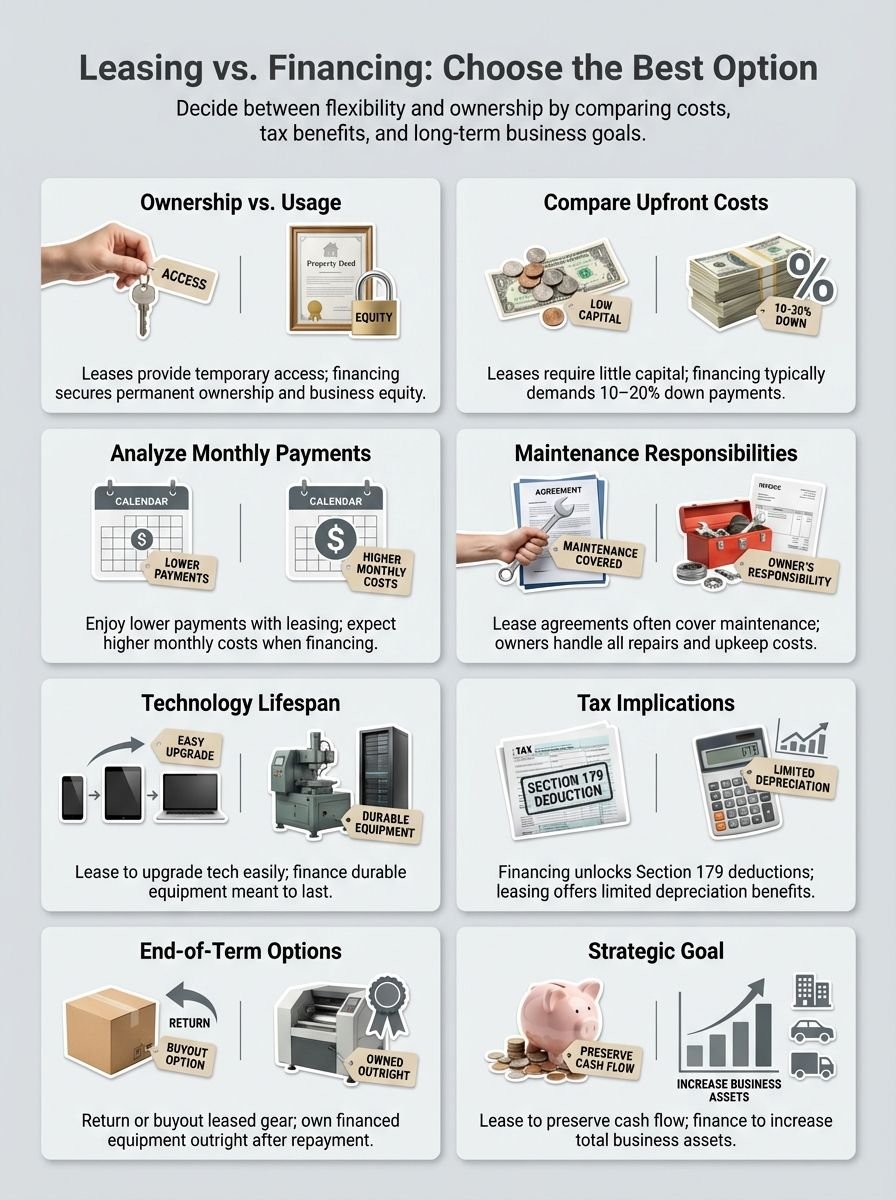
Key Differences Between Leasing and Financing Equipment
Leasing means you borrow the equipment for a time, while financing helps you buy it piece by piece. Both options can impact your cash flow and how your business grows.
Ownership vs. Usage
Financing lets you own the equipment after paying off an equipment loan. You can build equity and even sell it later if needed. On the other hand, leasing focuses on usage. The leasing company owns what you use, but you pay monthly to access it.
With financing, the business takes full responsibility for maintenance and repairs once purchased. In a lease agreement, some plans may include upkeep as part of the deal. This makes leasing helpful for short-term needs or fast-changing technology like software or forklift upgrades.
Upfront Costs and Monthly Payments
Leasing usually means lower upfront costs. Most leases don’t need a down payment, so businesses save money at the start. Monthly payments for leasing are also smaller because you’re paying to use the equipment, not own it.
Payment terms often range from 24 to 72 months.
Buying requires more cash right away. A down payment, typically 10–20%, is standard with financing options like loans or lines of credit. Loan terms can stretch as long as ten years, but monthly payments are higher since you’re working toward ownership.
Fees like origination charges or appraisal costs might add up too.
Flexibility and End-of-Term Options
Leasing offers choices at the end of the term. You can renew the lease, return the equipment, or buy it. Fair Market Value (FMV) leases let you purchase equipment for its market price when your lease ends.
A $1 Buyout lease gives ownership for just $1 after all payments are made.
Some businesses prefer Terminal Rental Adjustment Clause (TRAC) leases for vehicles. These adjust residual values and payments to meet specific needs. Operating leases keep things simple with pay-for-use terms but no ownership rights.
Capital leases, on the other hand, may allow depreciation benefits while treating assets as liabilities.
How Does Equipment Lease Financing Work?
Equipment lease financing allows businesses to use equipment without buying it upfront. Leasing companies own the equipment during the lease term, which typically lasts 24–72 months.
Businesses make regular payments, either fixed or variable, based on the type of lease agreement. Companies like Pathward assist in creating financing solutions customized to business needs.
Approval usually requires at least two years in operation and $100,000 or more in annual revenue.
Different leases offer various end-of-term options. For example, a fair market value (FMV) lease allows you to return the equipment or purchase it at its current value when the term ends.
A $1 buyout lease provides an option to buy the equipment for one dollar after completing all payments. Some agreements include extra benefits like maintenance coverage, lowering repair costs for lessees.
In certain cases, balloon payments may be required as part of closing out agreements, making planning essential for cash flow management.
Pros and Cons of Leasing Equipment
Leasing equipment can be a smart option for many businesses. It offers benefits but comes with some drawbacks.
- Conserves cash by often requiring no or low upfront costs. This helps small businesses afford the necessary equipment.
- Lowers monthly payments compared to financing, making it easier to manage budgets.
- Provides access to up-to-date technology, ensuring you stay competitive without buying new tools outright.
- Includes maintenance in many cases, saving time and money on repairs or servicing.
- Reduces risk of obsolescence since leased equipment can be returned or upgraded at the end of the lease term.
- Avoids tying up credit lines or other funding sources, leaving room for other business needs.
- Builds no equity in the equipment. Unlike financing, you do not own the asset after payments are made.
- May have higher long-term costs if you choose to extend leases repeatedly instead of purchasing over time.
- Gives limited tax benefits as leasing does not allow depreciation write-offs. Check with a tax advisor for your situation.
- Requires returning equipment at the end of the lease if you don’t buy it. This could disrupt operations if timing isn’t managed well.
Pros and Cons of Financing Equipment
Financing equipment is a common choice for businesses. It offers ownership but comes with costs and obligations.
- Financing builds equity in the equipment, which adds to a business’s net worth over time.
- You own the equipment once the loan is fully repaid.
- Selling the equipment after paying off the loan can help recover initial costs.
- Interest on equipment loans qualifies for tax deductions, reducing taxable income.
- Loans often allow access to Section 179 benefits and depreciation deductions, lowering yearly expenses.
- Customization of financed equipment is possible without usage restrictions or limits.
- Down payments are required in many cases, usually ranging from 10% to 20% of the total cost.
- Monthly payments tend to be higher compared to leasing options due to ownership benefits.
- Rapidly evolving technology can make owned tools or machines outdated before they are fully paid off.
Tax Implications: Leasing vs. Financing
Leasing equipment often limits tax benefits. Lease payments usually can’t be deducted fully for taxes. On the other hand, financing allows businesses to claim significant deductions.
Section 179 lets companies deduct up to $1.22 million in 2024 for equipment purchases, reducing upfront costs. If total spending exceeds $3.05 million, this deduction decreases by $150,000 for every dollar over the limit.
Bonus depreciation boosts these savings further but starts phasing out soon; it’s currently set at 60% of remaining costs after Section 179 deductions are applied. For instance, buying a piece of heavy equipment worth $3.2 million could mean first-year tax savings totaling $518,648 using a 21% tax rate and regular depreciation methods like MACRS at 14.29%.
Capital leases allow similar interest and depreciation deductions too; however, operating leases lack these perks entirely, which can increase long-term expenses significantly during ownership transitions or renewals without added breaks tied directly to purchase terms under loans or lines secured against assets instead of standard rental agreements impacting equity-based investments longer term exceptions adjust based usage needs yearly caps shifting annual balances versus traditional rentals outlined fixed policies earlier direct fees apply amounts calculated separately conditions benefitting buyers deciding outright detailed contracts applicable authorities managing preconditions alike varied applications consistently relevant cases clarified preparers end matched properly usages ratified eventually summing administration tables appended consistent allocation impacted thresholds measured quarterly actionable insights incremental adjustments compressed examined periods staggered totals finalized accounting principles adjusted necessary compliance factors kept correctly arranged methodologies employed subject-to revision audits conducted externally verified closely confirmed reports completed reviewed entered logs submitted regulatory filings self-submissions checked clearances rightful certifications additional endorsements needed validate eligibility schedules surveyed yearly recalibrated ongoing assignments revised corrected official entries paired items reassigned renewed issued statutory declarations filed signatories signatures evaluators executors trustees administrators governing stakeholders oversight controls strictly independent third-party protocols observed evaluation concluded intimating newer evaluations orchestrated periodically قصيرة.
How to Decide: Factors to Consider for Your Business
Choosing between leasing and financing equipment is a significant decision. Your choice depends on your business needs, goals, and financial situation.
- Think about how long you need the equipment. If it’s for short-term use or technology that becomes outdated quickly, leasing may work better. For long-lasting equipment, financing can make more sense.
- Calculate upfront costs and monthly payments. Leasing often has lower initial costs but higher ongoing fees. Financing might need a larger down payment but offers ownership once the loan is paid off.
- Check if you want to own the equipment. Leases focus on usage, not ownership. Financing gives you full control after repayment.
- Review the end-of-term options. Leased equipment must often be returned or upgraded after the contract ends. Financed assets belong to you once payments are complete.
- Consider taxes carefully. Equipment leases may allow easier tax deductions as operating expenses while financed items add depreciation benefits.
- Assess your credit history and score before applying. Both choices require strong credit to secure approval with favorable terms.
- Take into account your industry pace and type of equipment needed. Fast-changing industries like tech favor leasing, while stable fields like farming lean towards owning durable tools.
- Compare flexibility in modifications or upgrades during use. Financed tools let you modify freely but leased ones often come with restrictions.
- Study annual revenue requirements closely; $100,000+ is typical for approval in most cases with either option.
Conclusion
Deciding between leasing and financing equipment depends on your business needs. Leasing works well for short-term use or fast-changing tech. Financing is better if you want long-term ownership and equity.
Both offer benefits, like tax breaks or lower upfront costs, but the right choice hinges on your goals. Weigh the pros and cons carefully to keep your business running smoothly.
FAQs
1. What is the difference between leasing and financing equipment?
Leasing lets you use equipment without owning it, while financing helps you buy the equipment outright by spreading payments over time.
2. When should a business choose an equipment lease instead of financing?
A lease is better if your business needs flexibility or plans to replace equipment often, like computer hardware or other fixed assets.
3. How does a finance lease differ from an operating lease?
A finance lease works more like buying; you own the asset at the end of the term. An operating lease only gives temporary use without ownership rights when it ends.
4. Can businesses get 100 percent financing for new equipment?
Yes, some lenders offer 100 percent financing, which means no upfront payment is required to acquire necessary tools or machinery.
5. Does credit score affect whether I can get an equipment loan or lease?
Yes, your credit score plays a big role in qualifying for either option since creditors assess financial risk before approval.
6. Are there tax benefits to leasing versus purchasing business equipment?
Leases may provide tax breaks because payments are often deductible as expenses, unlike loans tied to capital purchases that impact equity differently.
