Starting a business is exciting, but paying for equipment upfront can drain your cash. Did you know the best small business equipment financing for startups can solve this problem? This guide will show you smart options to get the tools you need without breaking the bank.
Keep reading, your success might just start here!
Key Takeaways
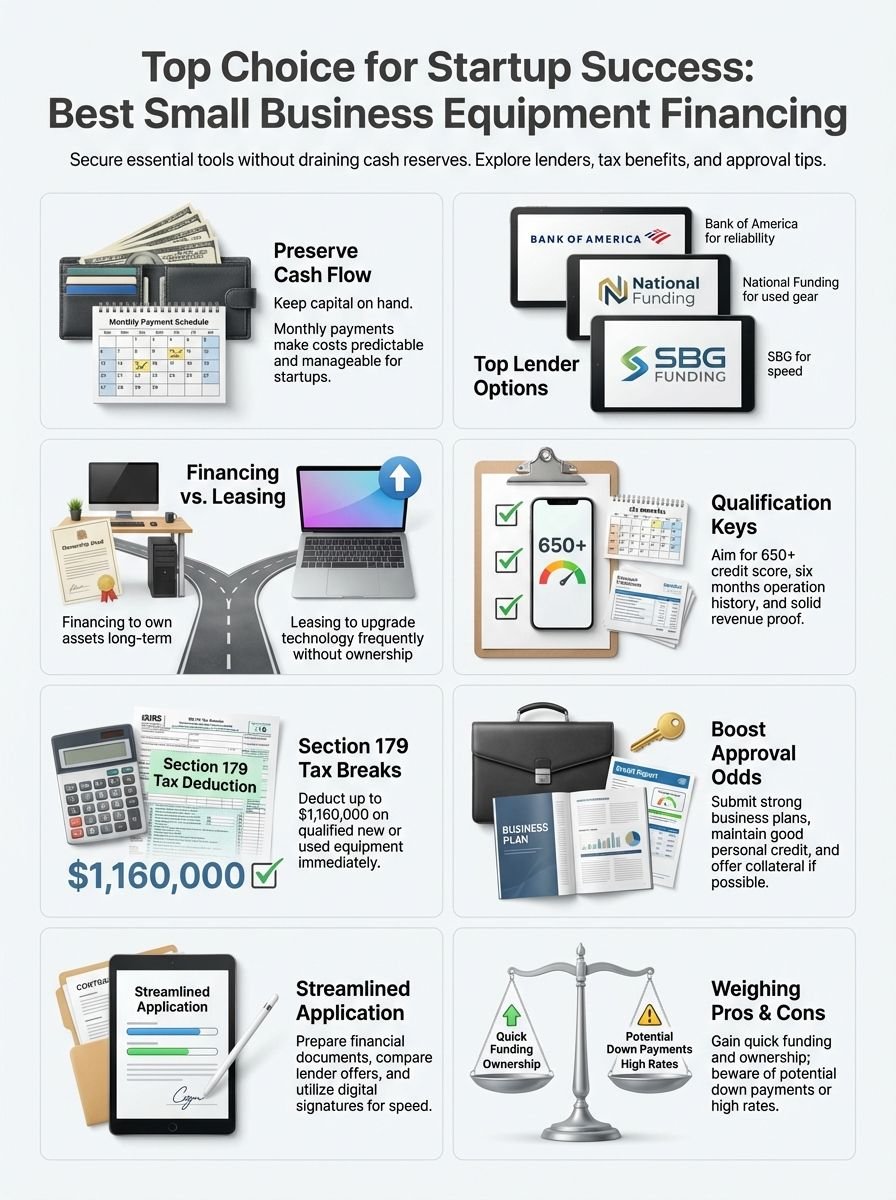
- Equipment financing helps startups save cash by covering 100% of costs, including delivery and installation. Loans range from $5,000 to $10 million, with terms customized to business needs.
- Top lenders include Bank of America for long-term options ($10,000+ loans at 8.50% APR), National Funding for used equipment ($5,000 to $500,000 fast approvals), and SBG Funding for quick funding within days.
- Section 179 tax rules allow businesses to deduct up to $1,160,000 on new or used equipment in the first year. Interest on equipment loans may also be tax-deductible.
- Leasing is ideal for tools needing frequent upgrades while financing suits those wanting ownership. Financing builds equity but may require higher monthly payments than leasing.
- Major industries like construction, healthcare, food service, and manufacturing benefit most from loans that help fund essential equipment without large upfront costs.
Key Benefits of Equipment Financing for Startups
Starting a business comes with many expenses, and buying equipment can drain your wallet fast. Equipment financing keeps more cash in your pocket, letting you grow without breaking the bank.
Preserving Cash Flow for Business Growth
Saving cash is vital for growing your business. Equipment loans let you buy what you need without draining your bank account. These loans often require no down payment, helping startups keep more money on hand for other expenses or investments.
Monthly payments make costs predictable, so planning gets easier. For example, a bakery can use financing to buy ovens and mixers right away while using profits from sales to cover the loan payments.
Some lenders even skip demanding financial checks for loans up to $250,000; this means less stress and quicker approvals.
Access to the Latest Equipment Without Full Upfront Costs
Paying the full price upfront for equipment can drain a startup’s cash. Equipment financing helps businesses avoid this burden. Lenders can provide amounts from $5,000 to $10 million, depending on your needs.
This means startups can secure heavy machinery or advanced technology without massive immediate expenses.
With financing, you get 100% coverage, including delivery and installation costs. A lease option often results in lower monthly payments while keeping access to modern tools. Some plans even let businesses match payments with seasonal revenue.
Startup companies benefit by upgrading equipment quickly, staying competitive without using all their capital reserves at once.
Top Lenders for Small Business Equipment Financing
Finding the right lender can feel like striking gold. The best choices depend on your needs, whether it’s speed, used equipment, or startup-friendly terms.
Best for Startups: Bank of America
Bank of America offers equipment financing starting at $10,000 with no upper limit. Loan terms range from 12 to 60 months, giving startups flexibility. Interest rates start at a competitive 8.50% APR.
Businesses need a credit score of 700 or higher and must have been operating for at least two years with $100,000 in annual revenue.
The bank stands out for its physical locations and free business credit scores for borrowers. This option is ideal for startups wanting reliable funding from a trusted name but requires meeting stricter eligibility criteria than some online lenders.
Best for Used Equipment: National Funding
National Funding is ideal for financing used equipment. They provide loans from $5,000 to $500,000 with a minimum credit score of 660. Your business only needs six months of operation and $250,000 annual revenue to qualify.
Approval is fast, and funds can arrive in just one day.
Prepayment discounts help lower costs if you pay early. No collateral is needed for lease agreements, making it easier for startups or small businesses. Factor rates start at 1.10+ but are finalized after application since there’s no online prequalification tool available upfront.
Perfect for getting the equipment your business needs without delays!
Best for Fast Approvals: SBG Funding
SBG Funding is a strong choice for business owners who need equipment quickly. They specialize in fast approvals, helping startups get funding without long waits. Many online lenders take days to approve, but SBG Funding aims to move faster.
Speed matters when you need new or used equipment for your business operations.
Their process skips the hassle of traditional banks. Prequalification may not require a hard credit pull, saving time and protecting your credit score. Some competitors, like SMB Compass or National Funding, also provide funding within one day after approval, but SBG remains an industry favorite for quick turnaround times.
If scaling your startup depends on getting financing fast, they can deliver solutions right on time.
Equipment Financing vs. Equipment Leasing
Equipment financing lets you own the equipment after paying off the loan. Leasing, on the other hand, only gives you temporary use of it. Loans usually come with fixed monthly payments and may cover up to 100% of costs, including delivery or installation fees.
Leases often have lower monthly payments but rarely include ownership unless there’s a buyout option at the end.
Leasing works well for quickly changing tech or tools that need frequent upgrades. Financing is better if you want long-term control over your assets. A lease might allow upgrades to newer models at the end of its term, while owning through financing builds equity in your business assets.
Choose based on how long you’ll use the equipment and whether owning it adds value to your operations.
How to Qualify for Small Business Equipment Financing
Getting approved for small business equipment financing can feel like a big step. Follow these key steps to increase your chances.
- Maintain a solid credit score. Lenders often look for scores of 650 or higher, but some accept as low as 550.
- Show your time in business. Many lenders prefer startups with at least six months of operation, like National Funding or Taycor Financial.
- Meet annual revenue requirements. Most lenders need proof that your business earns $50,000 to $350,000 yearly, depending on the lender’s terms.
- Gather the right paperwork. This may include tax returns, bank statements, and an equipment appraisal.
- Use personal guarantees wisely. A co-signer or collateral can improve approval odds if you are just starting out.
- Be clear about the equipment value and purpose. Lenders prefer funding items essential to your business with measurable impact.
- Find lenders that match your needs. Some options specialize in fast approvals (SBG Funding) or specific types like used equipment (National Funding).
- Build strong financials if needed. Companies like Crest Capital approve loans under $250,000 without requiring financial statements.
- Highlight industry experience in applications. Even new businesses gain trust if owners show expertise in their fields.
- Plan for down payments if required by specific lenders or programs designed for startups.
Tax Advantages of Equipment Financing (Section 179 Benefits)
Section 179 lets small businesses deduct up to $1,160,000 in the first year on qualified equipment. This tax rule applies to both new and used equipment, as long as it is new to your business.
Buying heavy machinery or medical tools? You may save big on taxes while building assets for growth.
Interest paid on an equipment loan can also be tax-deductible. Leasing agreements often don’t qualify for Section 179 benefits unless structured correctly. Using financing programs helps companies cut costs, keeping more money in their pockets.
Tools like Crest Capital’s Tax Calculator make estimating savings easy!
Tips to Increase Approval Chances for Startups
Getting equipment financing as a startup can feel tricky, but there are ways to boost your chances. Follow these tips to make your application stand out.
- Show a strong business plan. Explain how the equipment will grow your business and increase income. Lenders like clear goals backed by facts.
- Keep personal credit in good shape. A solid credit score builds trust with lenders, even if your business is new.
- Offer collateral when possible. Using assets like inventory or property can ease lender concerns over risks.
- Add a co-signer if needed. Someone with strong financial health can strengthen your loan request.
- Choose equipment wisely. Pick machines or tools directly tied to daily work for better approval odds.
- Work with experienced lenders for startups, such as Beacon Funding or Taycor Financial, who understand new businesses.
- Gather all required documents early on. This includes credit reports, tax returns, and details about the equipment you plan to buy.
- If you have cash reserves, mention them in your application too; it shows responsibility and readiness to handle payments.
- Highlight any industry experience you have before applying; this reassures lenders of your ability to manage the business successfully!
Steps to Apply for Equipment Financing Successfully
Applying for equipment financing can feel like a big task, but it doesn’t have to be. Following clear steps will help you save time and get closer to approval.
- Gather your financial documents early. Lenders often want bank statements, tax returns, and financial records. This shows them that you’re serious about the loan.
- Fill out a one-page application online. Most lenders ask for company details, industry type, and the equipment you want to finance.
- Use lender tools to estimate payments. Online calculators help you see what monthly costs might look like before applying.
- Compare offers from multiple lenders. Check interest rates (APR), requirements, down payments, and funding speed.
- Prequalify with no impact on credit score if possible. Some lenders let you test eligibility without hard credit checks.
- Be specific about the equipment needed in your request. Vendors may contact the lender directly after approval for payment transfers.
- Sign required documents electronically once approved. Many companies speed up this process by allowing digital signatures.
- Work with a lender offering fast approvals if needed quickly. Some approve loans as high as $250,000 within 48 hours or less!
Common Industries Benefiting from Equipment Financing
Many industries rely on equipment financing to grow and succeed. It helps businesses get the tools they need without draining their cash.
- Construction
Heavy machinery, vehicles, and specialized tools are costly. Equipment financing helps construction companies pay for bulldozers, excavators, and cranes over time. - Professional Services
IT services often need top-tier software, computers, and office gear. Financing ensures companies stay updated without massive upfront investment. - Manufacturing
Production lines depend on expensive machines. With loans, manufacturers can afford packaging systems, assembly lines, and printing equipment. - Food Processing
Industrial kitchens require ovens, mixers, and other high-tech tools to run smoothly. Financing eases the burden of buying these essential items. - Landscaping
Landscapers frequently need trucks, mowers, or snow removal equipment depending on the season. Loans make it possible to buy what they need. - Medical and Healthcare
Healthcare providers often use costly diagnostic or treatment devices like X-ray machines or ultrasounds. Financing covers these crucial investments. - Transportation Businesses
Boom trucks, tow trucks, or septic pumper trucks keep this industry moving forward. Equipment loans fund these vehicles without straining resources. - Decorated Apparel Companies
Screen printers or embroidery machines are essential in this field but not cheap to own outright. Financing helps startups manage these costs wisely. - Food Service Businesses
Restaurants need stoves, refrigeration units, or even delivery vehicles. Financial options make purchasing easier for small businesses in food service sectors!
Pros and Cons of Equipment Financing
Equipment financing has clear advantages, but there are also potential drawbacks. Here’s a quick breakdown to help weigh the good with the bad:
| Pros | Cons |
|---|---|
| Quick funding is possible, sometimes even on the same day with online lenders. | Loan purpose is strictly limited to equipment, not general business expenses. |
| Collateral is often limited to the equipment itself, reducing personal asset risk. | Some lenders require a 10–20% down payment, which can strain cash flow. |
| Predictable fixed monthly payments make budgeting easier for startups. | Interest rates may be higher for borrowers with lower credit scores or histories. |
| Ownership of the equipment at the end of the loan term can build business equity. | Loan terms exceeding the equipment’s useful life can result in negative equity. |
| Helps businesses access the latest tools without full upfront costs. | Not ideal for startups with poor financial records or no credit history. |
Every coin has two sides. Evaluate both before making a decision. Sometimes speed or flexibility costs more, but it can keep the business moving forward.
Conclusion
Picking the right equipment financing can change your startup’s future. It helps you grow without draining your cash. With so many lenders and options, there’s a perfect fit for every business need.
Small steps today lead to big successes tomorrow. Take that leap and find the best financing to fuel your dream!
For those in the transportation sector looking for specific equipment financing options, be sure to check out our guide on the best semi-truck loans in California.
FAQs
1. What is equipment financing, and how does it work?
Equipment financing is a loan or lease used to purchase business equipment like furniture, medical tools, or heavy machinery. The lender provides funds secured by the equipment itself, and you repay over time.
2. How do I find the best small business equipment financing options?
Compare different finance companies and lenders based on interest rates, terms, and repayment flexibility. Use an equipment loan calculator to estimate costs before deciding.
3. Should I choose an equipment loan or lease for my startup?
It depends on your needs. A loan lets you own the equipment outright after payment, while leasing allows you to return it at the end of the term if it’s no longer needed.
4. Can startups qualify for business equipment loans?
Yes! Many lenders offer loans specifically designed for startups to help them scale their businesses without large upfront costs.
5. Is collateral required for all types of equipment financing?
Not always; some loans are unsecured debt with higher interest rates, but most require collateral like the purchased equipment itself.
6. Are there tax benefits when using an equipment financing option?
Yes! Equipment purchases may qualify as tax deductions under certain conditions in the United States, helping reduce overall expenses for your business finances.
