
Financing construction equipment can feel tricky. Many business owners wonder, “How long can you finance construction equipment?” Most loans range from one to five years, depending on the equipment’s useful life.
This guide will break down loan options, terms, and tips to help you choose the best fit for your business needs. Keep reading—you’ll find answers here!
Key Takeaways
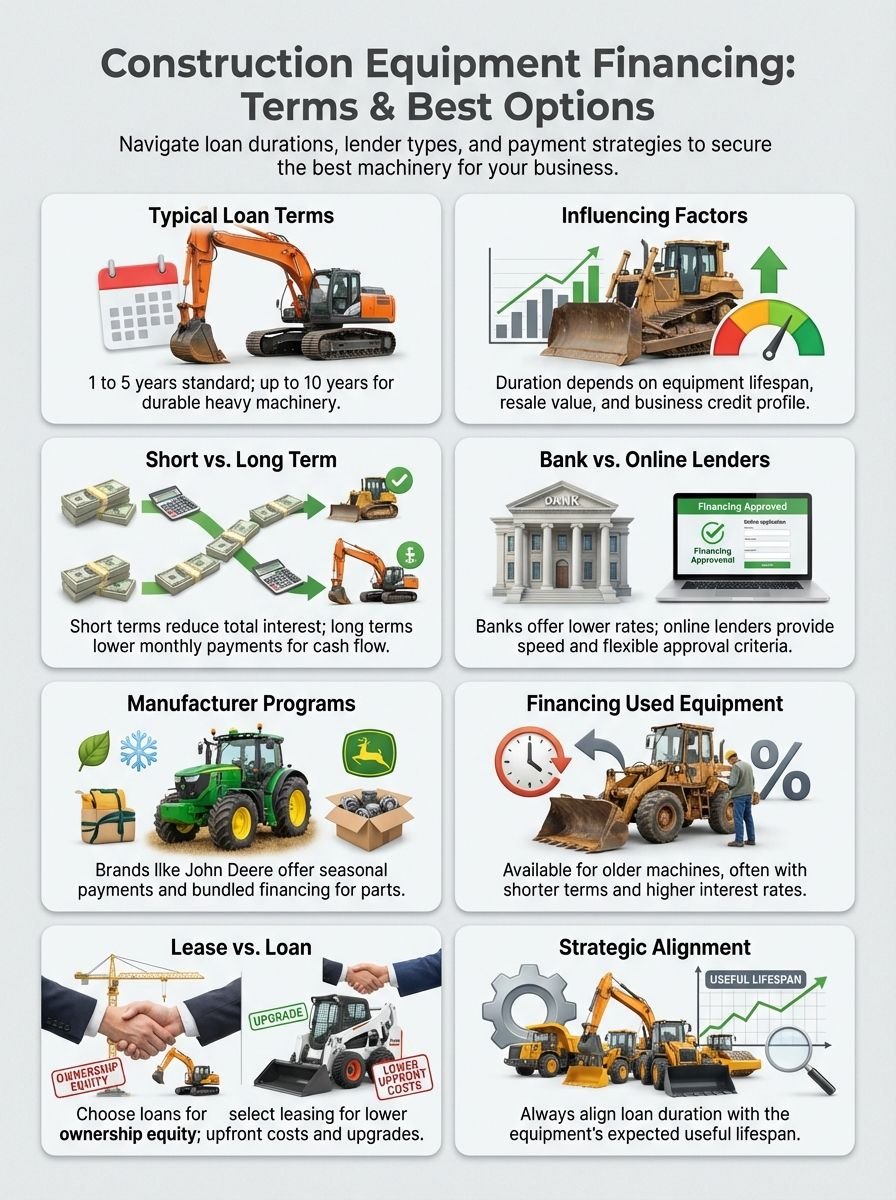
- Financing terms for construction equipment range from 1 to 5 years, but can extend up to 10 years based on the equipment’s lifespan.
- Short-term loans (6–24 months) have higher monthly payments but save on total interest, while long-term loans (3–7 years) lower payments yet increase total interest costs.
- Banks offer appealing rates and extended terms but require strong credit and financial records; online lenders provide faster approvals for businesses with limited history.
- Manufacturer financing programs like John Deere Financial often include flexible plans, seasonal payment options, or used equipment funding.
- Used equipment can be financed but might involve inspections, shorter loan lengths, or higher interest due to age-related risks.
Typical Terms for Financing Construction Equipment
Loan terms for construction equipment often range from 1 to 5 years. Most agreements fall between 24 and 60 months, or about 2 to 5 years. Some lenders may stretch terms up to 10 years based on the equipment’s lifespan, like an excavator with a useful life of roughly 10,000 working hours.
Shorter loan durations of around 6 to 18 months are common for heavy machinery. Longer loans mean smaller monthly payments but can lead to more interest paid over time. Lenders base loan lengths on factors like the type of equipment you’re financing, its expected wear and tear, and your business credit profile.
Factors That Influence Loan Duration
The type of construction equipment affects how long you can finance it. Heavy equipment like bulldozers or backhoes, which last longer, often qualify for longer repayment terms. Businesses buying items with a shorter lifespan, like technology-based tools that may quickly become outdated, usually face shorter loan lengths.
Lenders also consider whether the piece of equipment will still hold value when the loan is paid off.
Your business credit score has a big impact too. A strong score shows lenders you are less risky and can repay on time. Companies with financial stability and steady revenue streams tend to get better terms.
Some industries, such as manufacturing or retail, need specific terms based on how fast their assets lose value or generate income over time. Each lender sets different criteria; one bank might approve five years while another offers three for similar pieces of machinery.
Lenders care about two key things: your ability to make payments and the future worth of what you’re buying.
Short-Term vs. Long-Term Equipment Loans
Short-term and long-term loans offer businesses different ways to finance construction equipment, each with distinct pros and cons. Choosing depends on your cash flow, equipment lifespan, and financial goals. Below is a side-by-side comparison to highlight the key differences.
| Category | Short-Term Loans | Long-Term Loans |
|---|---|---|
| Loan Duration | 6 to 24 months | 3 to 7 years |
| Monthly Payments | Higher payments | Lower payments |
| Total Interest Paid | Lower total interest | Higher total interest |
| Equipment Obsolescence | Good for rapidly aging equipment | Risk of outdated machinery before loan ends |
| Cash Flow Needs | Strains cash flow short-term | Eases monthly cash flow |
| Best Use Case | Quick projects or seasonal needs | Long-term, stable equipment |
| Example | Financing an excavator for a 12-month contract | Purchasing a crane for ongoing large-scale projects |
Short-term loans work well for businesses avoiding heavy interest or equipment that ages fast. Think about a backhoe on a one-year construction project. Long-term loans shine when buying durable, essential machinery like cranes or bulldozers. Every business must weigh its priorities before deciding.https://www.youtube.com/watch?v=MaezmgoHVDI
How Loan Length Affects Monthly Payments and Interest Rates
Longer loan terms lead to lower monthly payments but result in higher total interest payments over time. For instance, a 60-month loan distributes the cost, keeping payments easier to handle.
Yet, businesses end up paying more in overall interest by extending the term.
Shorter loans reduce total costs as they shorten the period during which interest accumulates. A 24-month loan may involve higher monthly payments but decreases overall expenses. Companies should evaluate cash flow requirements and the lifespan of equipment to determine the appropriate balance for heavy equipment financing.
Best Loan Options for Construction Equipment Financing
Finding the right loan for construction equipment can feel like picking the perfect tool from a packed toolbox. Plenty of lenders offer business-friendly solutions, so you can get the equipment your company needs without breaking the bank.
Bank Loans
Traditional banks offer competitive rates for construction equipment financing. They are often best for businesses with strong credit. Banks usually provide longer loan terms that match the lifespan of the equipment.
Loan terms can last up to ten years, depending on the type of equipment you purchase.
Approval processes at banks take time and require solid financial records. Down payments and collateral amounts are higher compared to other lenders. Fixed interest rates make payments predictable but might feel less flexible if cash flow tightens.
Businesses seeking lower monthly costs and stable repayment plans often choose bank loans as their financing solution.
Online Lenders
Online lenders offer quick funding for construction equipment loans. They can approve applications in as little as 24–48 hours, which helps businesses needing equipment fast. Companies like National Business Capital use technology to simplify the application process and reduce waiting times.
These lenders often accept borrowers with limited credit history or startups that banks might reject. They provide flexible loan terms suited to specific industries, including construction companies needing heavy equipment.
While interest rates may be higher than traditional loans, the speed and convenience make them a practical choice for many small businesses. Digital tools like online calculators also assist in estimating payments quickly during the application process.
Manufacturer Financing Programs
Manufacturer financing programs offer direct loans for buying heavy and compact construction equipment. John Deere Financial, a top provider, covers items like dozers, excavators, and loaders.
They also have flexible “Buy Now Pay Later” plans to help businesses manage cash flow. With multi-use accounts such as PowerPlan Account, companies can finance parts or worksite costs along with equipment.
Special deals like discounts are often available on new purchases through these programs. Seasonal payment options cater to businesses with uneven income throughout the year. Used construction equipment can also be financed at local John Deere dealers, giving more flexibility for different budgets.
Clear customer support and online tools make the process simple for buyers.
Best Equipment Financing Options for Small Businesses
Small businesses can explore several equipment financing options to grow their operations. SBA loans, like the 7(a) Loan, offer low down payments and long terms. They work well for businesses with strong credit but need time for approval.
Banks also provide secured loans using the equipment as collateral, which may mean lower interest rates.
Online lenders give faster approvals with flexible financing solutions customized for small companies’ needs. These often require less paperwork but come with higher interest rates than traditional banks.
Leasing is another choice that avoids large upfront costs and provides fixed monthly payments, helping you get the equipment you need without draining cash flow.
Can You Finance Used Construction Equipment?
Yes, used construction equipment can be financed. Programs like John Deere Financial and local dealers offer options for businesses in need of heavy equipment. Used equipment often costs less than new, helping lower upfront expenses.
This is useful for maintaining working capital while still making key purchases.
Lenders may require inspections or appraisals to approve loans on used items. Loan terms might also be shorter due to the reduced lifespan of older machines. Rates could be higher since lenders take on more risk with aging assets.
Tools like PowerPlan accounts can even cover financing needs for attachments or services linked to both new and pre-owned gear, keeping your business running smoothly without tying up cash flow.
Loan Options for Startups or New Businesses
Starting a new business is exciting, but financing equipment can be tricky. Many lenders consider startups risky, so options are often limited.
- Bank Loans
Banks may offer loans, but startups need strong business plans and good credit scores. Loan terms can be shorter with higher interest rates for new businesses. Banks may also ask for collateral or a personal guarantee. - SBA Loans
The Small Business Administration (SBA) offers SBA 7(a) and SBA 504 loans. These loans have longer approval times but provide lower interest rates. They require detailed documents, including cash flow projections. - Online Lenders
Online lenders approve loans faster than banks. They are more likely to work with businesses that have little history or revenue. Keep in mind, they usually charge higher interest rates compared to traditional choices. - Manufacturer Financing Programs
Some equipment manufacturers provide financing directly to buyers. These programs may suit startups with seasonal cash flows or smaller budgets. Interest rates depend on the type of equipment you want to buy. - Equipment Leasing
Leasing is an attractive option for many startups because it requires less upfront money. Payments are usually lower too, which can help keep early expenses manageable while growing your business. - Business Credit Cards
If you need quick capital for small equipment purchases, credit cards can help bridge the gap short-term. Watch out for high interest rates if balances are not paid off quickly. - Friends and Family Loans
Some entrepreneurs rely on personal networks for small-business funding instead of traditional creditors or lenders requiring detailed applications or collateral agreements. - Lines of Credit
A line of credit allows access to funds as needed up to an approved limit without taking one large loan at once; this helps reduce unnecessary debt when planning inventory additions alongside large investments like skid-steer loaders etc., yet still flexible enough covering part-payment upfront costs downpayments signed contracts machinery forklifts refinances unpredictable quarterly incoming/monthly revenue….
Lease vs. Loan: Which is Better for Construction Equipment?
Loans let you own the equipment outright. This builds equity and can help your business in the long run. They work well for equipment with a long life, like loaders or bulldozers. Loans usually require a down payment, but they provide unlimited usage of the equipment.
Leases keep upfront costs lower. Payments might include maintenance, helping reduce extra expenses. Leasing works best for rapidly changing technology or short-term needs. You can often upgrade to new models easily.
The choice depends on cash flow, how long you’ll use the equipment, and your growth goals.
Special Considerations for Private Seller or Auction Purchases
Financing equipment from private sellers or auctions comes with risks. Lenders often place stricter terms or higher interest rates on these purchases due to uncertainty. Before applying for an equipment loan, confirm proof of ownership and a clear title.
Hidden liens can cause legal trouble later.
Auction purchases may require fast payment, so pre-approved financing is crucial. Inspect the equipment carefully; unseen issues can lead to costly repairs. Insurance coverage and warranties are extra layers of protection worth having.
Some lenders provide specialized loans for auction buys, but options might be limited compared to dealer sales.
Tips for Choosing the Right Financing Term
Choosing the right financing term is essential for your business. An incorrect choice could impact your cash flow or increase total costs.
- Align the loan duration with the lifespan of the equipment. For example, if a loader is expected to last 8 years, opt for a loan term that matches this period.
- Shorter terms lower interest but increase monthly payments. Consider what your budget can manage each month.
- Longer loans result in smaller payments but higher overall interest costs. Balance this with your business objectives.
- Evaluate how quickly technology changes in your industry. Equipment like forklifts might last for decades, while other machines may become outdated more rapidly.
- Utilize loan calculators to understand how various terms impact payments and interest. Free online tools are available to simplify this process.
- Analyze your cash flow forecasts before committing to a term. This helps ensure you stay within your financial capabilities.
- Examine penalties for early payoff. Some lenders impose fees if you decide to settle the loan ahead of schedule.
- Explore options from banks, online lenders, and manufacturers. Each offers unique rates and terms for heavy equipment financing.
- Be cautious with balloon payment deals unless you’re confident you’ll have the funds to cover large payments at the end of the loan.
- Seek guidance from financial experts or accountants if you’re uncertain. They can assist in maximizing tax benefits and selecting the best financing terms.
Conclusion
Financing construction equipment doesn’t have to be tricky. Loan terms can range from short to long, giving flexibility based on your needs. Shorter loans save on interest, while longer ones free up cash flow.
Pick a plan that fits your budget and the life of the machine. The right choice will help your business grow while keeping costs manageable.
FAQs
1. How long can you finance construction equipment?
The financing term for construction equipment typically ranges from 12 months to 7 years, depending on the kind of equipment, its price, and the lender’s requirements.
2. What factors affect the loan term length for heavy equipment?
Several factors play a role, including the type of business equipment being purchased, whether it’s new or used, the life of the equipment, and your time in business.
3. Should I buy or lease construction equipment?
Buying lets you own the machine outright after paying off the loan. Leasing often has lower monthly payments but doesn’t provide ownership unless there’s a purchase option at the end.
4. Can an SBA 7(a) Loan be used for financing heavy machinery?
Yes! An SBA 7(a) Loan can help businesses get an equipment loan with longer terms and fixed interest rates to grow their operations effectively.
5. Do lenders require collateral for an equipment loan?
Yes, lenders often require collateral like manufacturing or construction machines themselves as security to reduce their risk if payments aren’t made.
6. Is refinancing possible during my loan term?
Refinancing is possible if you want better rates or need to adjust your payment structure over time; it could also help lower your monthly payments based on current needs.
