
Getting the right equipment can be a challenge for many businesses, especially with tight budgets. Equipment financing is a smart way to buy what you need without emptying your bank account.
In this post, we’ll highlight top equipment financing companies that offer great options for different needs. Keep reading to find the best fit for your business!
Key Takeaways
- Equipment financing helps businesses buy tools, vehicles, and software without paying upfront. Loan amounts go up to $5.5 million with terms as long as 10 years.
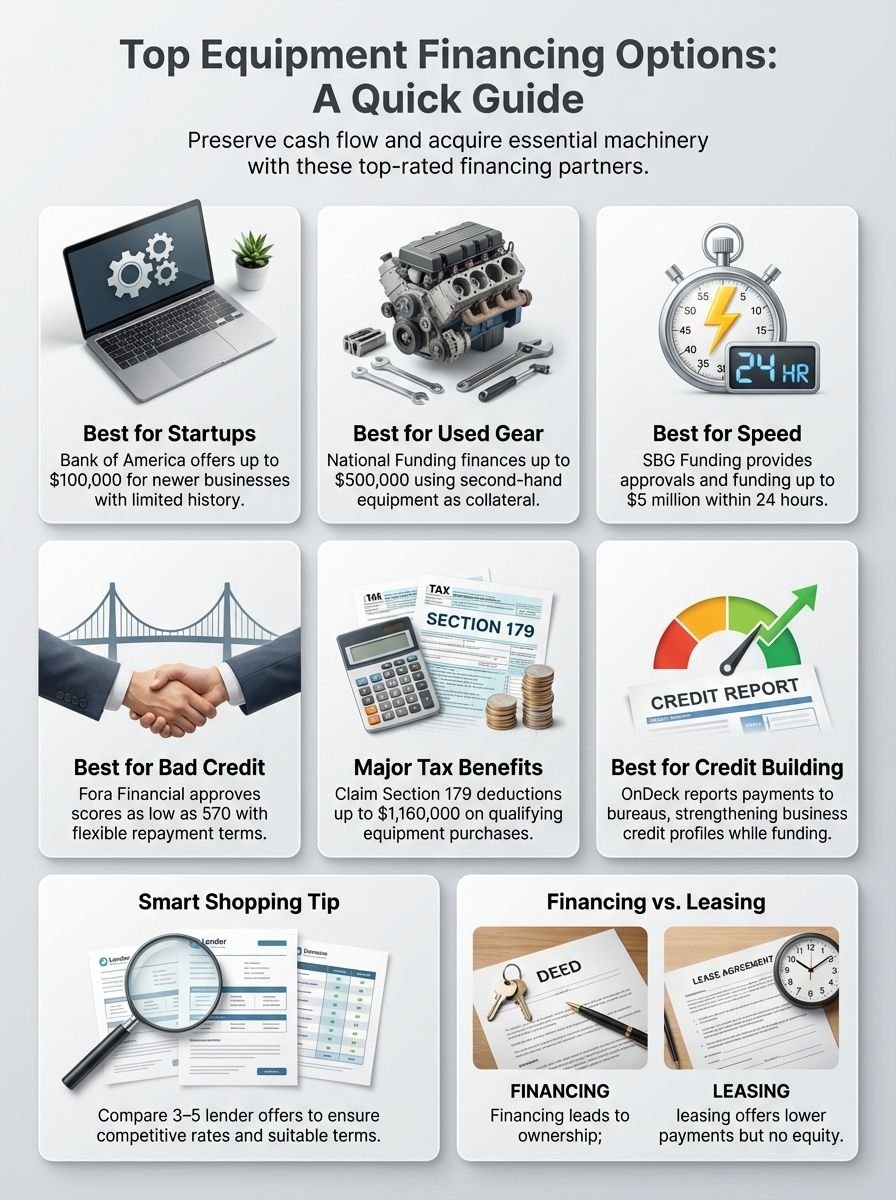
- Bank of America is great for newer businesses needing up to $100,000 in financing with an APR starting at 6.75%. National Funding works well for used equipment, offering loans up to $500,000 and funding within 24 hours.
- Section 179 offers a tax deduction of up to $1,160,000 on qualifying equipment in 2024. This can save businesses money during tax season.
- SBG Funding provides fast approvals and loans of up to $5 million in just 24 hours for companies operating at least six months with credit scores over 600.
- Comparing lenders by rates, fees, loan terms (like flexible payments), support quality, and minimum qualifications ensures the best deal for your business needs.
What is Equipment Financing?
Equipment financing helps businesses purchase tools, software, or vehicles without paying the full price upfront. You borrow money from a lender to buy equipment and pay it back over time with interest.
The item you buy acts as collateral for the loan.
This type of financing works well for both new and used items, even those up to 10 years old. Loan amounts can go as high as $5.5 million, with terms up to 10 years. Some agreements let you own the equipment fully, like an Equipment Financing Agreement, while others give options to return or renew based on its fair market value.
Benefits of Equipment Financing
Spreading equipment costs over time keeps your cash flow strong. Predictable monthly payments make budgeting easier and reduce financial stress. Some financing options cover the total cost, often with zero down payment.
You can claim up to $1,160,000 as a Section 179 tax deduction for new business equipment. This helps save money during tax season. Financing also covers extra expenses like shipping or installation, up to 25% of the equipment value.
It allows you to upgrade outdated machinery quickly without using all your working capital upfront.
Key Features to Look for in Equipment Financing Companies
Look for fast approvals. Many lenders offer same-day approvals for amounts up to $250,000. Skip the headache of tax returns and financial statements; some don’t require them for loans under that amount.
Choose companies offering flexible payment options like monthly or seasonal plans.
Focus on transparency. Avoid lenders with hidden fees or charges. Some even skip personal guarantees or cross-collateral requirements, making borrowing less risky. Tools like payment calculators and Section 179 calculators can simplify decision-making too.
Top Equipment Financing Companies
Finding the right lender can save you time and money. Each company offers unique strengths, so choose what fits your needs best!
Best for Newer Businesses: Bank of America
Bank of America offers up to $100,000 in equipment financing. Their loans suit small businesses with limited credit history. A personal credit score of 700 or more is required to qualify.
They provide options like term loans, secured loans, and lines of credit.
The APR starts at 6.75%, which is competitive for newer businesses. Loan terms go up to five years, helping spread out payments over time. Funds can cover various needs beyond buying equipment, making it a flexible choice for growing companies.
Best for Used Equipment: National Funding
National Funding offers equipment financing up to $500,000, making it a strong option for businesses purchasing used assets. It accepts both leased and second-hand equipment as collateral.
Funds can be available within 24 hours after approval, helping businesses move quickly.
The company requires a minimum credit score of 620 to qualify. While factor rates start at 1.10, costs may run higher compared to competitors. Origination fees and flexible payment schedules might apply too, giving business owners choices but also potential added expenses.
For companies needing quick cash for older gear, this lender gets the job done efficiently!
Best for Fast Funding: SBG Funding
SBG Funding offers lightning-fast equipment financing. Businesses can secure loans of up to $5 million with approvals and funding completed in as little as 24 hours. Monthly interest rates start at a competitive 1.75%, making it attractive for companies needing quick access to funds without high costs.
To qualify, your business must have operated for at least six months, and a credit score of 600 or higher is typically required. Strong annual revenue boosts approval chances. SBG also provides flexibility by offering both term loans and lines of credit, catering to different funding needs.
Positive customer reviews on Trustpilot highlight their reliable service, giving you added peace of mind when securing capital for equipment purchases.
Best for Building Business Credit: OnDeck
OnDeck offers equipment financing loans up to $250,000 with a maximum two-year term. They also provide business lines of credit up to $100,000 for 12 to 24 months. Their funding is fast and straightforward.
Using only a 1.10 factor rate, they keep costs predictable for businesses. No extra collateral is needed outside of the financed equipment.
This lender reports payments to business credit bureaus, which helps improve your credit profile over time. To qualify, you need at least one year in business and an annual revenue of $100,000 or more.
OnDeck’s options are ideal for businesses looking to establish or strengthen their financial standing while accessing critical funds quickly.
Best for Bad Credit: Fora Financial
Fora Financial offers equipment financing for businesses with poor credit. They accept credit scores as low as 570. Businesses only need six months of operation and $240,000 in annual revenue to qualify.
This makes it a great option if banks have turned you down.
Financing amounts go up to $1.5 million with terms lasting up to two years. They use a 1.10 factor rate instead of traditional interest rates. Fora Financial also provides flexible options like lines of credit or revenue-based financing, but they don’t report payments to business credit bureaus, which won’t help build business credit history.
It’s ideal for companies needing quick funding without strict requirements!
How to Apply for Equipment Financing
Getting equipment financing is a simple process if you follow the right steps. Most applications can be completed quickly, and funds are often available within days.
- Fill out an online application form. Many lenders, like Lendio, allow you to submit a one-page form in minutes. This process does not impact your credit score.
- Gather necessary documents. These may include recent bank statements, tax returns, and your business license.
- Check for prequalification offers. Apply to multiple lenders to compare terms and rates without harming your credit.
- Wait for approval decisions. For amounts under $250,000, same-day approvals are common. Larger loan requests may take 24–48 hours.
- Review loan terms carefully before accepting an offer. Look at interest rates, repayment periods, and any fees involved.
- Sign documents electronically after choosing a lender’s offer you like best. E-signatures make this step faster than traditional paperwork.
- Receive your funding once everything is finalized! Funds are sent directly to the vendor in most cases so your business can start using the equipment immediately.
Stick with these steps to secure the equipment you need fast!
Equipment Financing vs. Leasing: Key Differences
Equipment financing and leasing are often compared as ways to obtain business assets. Both options have their benefits and drawbacks, making the choice dependent on business needs. Below is a breakdown of the major differences.
| Aspect | Equipment Financing | Equipment Leasing |
|---|---|---|
| Ownership | The borrower owns the equipment after paying off the loan. | The leasing company retains ownership unless a buyout option is exercised. |
| Monthly Payments | Payments may be higher since the goal is to own the asset. | Generally lower payments compared to financing. |
| Upfront Costs | Usually requires a down payment, typically 10% to 20% of the equipment cost. | May not require a down payment, but security deposits could apply. |
| Tax Benefits | Interest paid on loans can often be tax deductible. Purchases may qualify for Section 179 deductions. | Leasing payments may not offer the same tax advantages as financing. |
| Flexibility | Offers the ability to prepay the loan, often reducing total interest paid. | Less flexibility since terms are fixed, and prepayment doesn’t reduce costs. |
| Long-Term Cost | May result in lower total expenses since the borrower owns the asset. | Typically higher total costs as lease payments cover usage, not ownership. |
| Term Length | Ranges from 1 to 10 years, depending on the loan and lender. | Varies widely, often shorter-term compared to financing. |
| Suitable For | Businesses that want to build equity in essential equipment. | Companies needing short-term use without a need for ownership. |
The table above simplifies the differences. Each option offers distinct advantages. Businesses should evaluate costs, requirements, and objectives before deciding.
Factors to Compare When Choosing a Lender
Choosing the right lender can save your business time and money. Compare these key factors before signing an agreement.
- Interest Rates and APRs
Lower rates mean smaller payments. Some lenders offer rates like 6.75% APR, while others charge higher amounts. - Loan Amounts
Check how much funding is available. Loan sizes range from $20,000 to $5 million depending on the company. - Repayment Terms
Look at payment flexibility. Options may include monthly, quarterly, or even deferred payments for some businesses. - Approval Speed
Quick approval can be critical during busy seasons. Some lenders fund loans within 24–48 hours. - Eligibility Requirements
Review what’s needed to qualify. Most lenders ask for a minimum credit score, a certain revenue level, or years in business. - Lender Reputation
Research reviews and ratings through sites like Trustpilot or Better Business Bureau for insight into customer experiences. - Fees and Charges
Watch out for origination costs and hidden fees. Prepayment penalties could also increase your total cost over time. - Equipment Type Restrictions
Confirm if financing works for both new and used equipment or specific tools like heavy trucks or computers. - Collateral Rules
Some loans are secured by equipment itself; this helps reduce risk but impacts ownership during repayment periods. - Customer Support Quality
Reliable support matters in case issues arise later on loan details or repayments plans!
Minimum Requirements for Equipment Financing
Equipment financing can help businesses get the tools they need without spending all their cash. Lenders have specific rules you must meet to qualify.
- A minimum credit score is often required. Most lenders look for a score of at least 650, but some accept scores as low as 520.
- Your business revenue matters. Many lenders ask for annual earnings of $50,000 or more to approve your equipment loan.
- Time in business is key too. Some companies require at least one year of operations, while others accept newer businesses or startups.
- The type and value of the equipment you want may affect approval. High-cost machinery or specialized tools could lead to stricter terms.
- If you’re a startup, expectations rise. Startups might qualify with lower loan amounts but face tougher conditions like higher rates.
- Solid borrowing history helps your case. Lenders feel more confident when they see you’ve repaid prior loans on time.
- Business ownership length may be checked. At least two years under current management is sometimes required by lenders.
- Higher financing amounts call for strong income streams. Businesses with high monthly or yearly revenues are better positioned for larger loans.
- Collateral requirements vary based on the lender and equipment type. Often, the financed equipment itself serves as collateral.
Pros and Cons of Equipment Financing
Some businesses thrive with equipment financing, but it’s not a one-size-fits-all solution. Knowing the pros and cons can help you decide if it’s the right move for your company. Here’s a quick breakdown:
| Pros | Cons |
|---|---|
| Lower interest rates compared to other business loans. | Funds are tied to equipment purchases only. |
| Fast funding, sometimes within the same day. | Potential upfront down payment may be required. |
| No additional collateral needed, as the equipment itself secures the loan. | Loan term may outlast the useful life of some equipment. |
| Fixed monthly payments allow for consistent budgeting. | Maintenance and repair costs fall on the borrower. |
| Ownership of the equipment transfers after repayment. | Not ideal for items at risk of becoming quickly outdated. |
| Tax-deductible interest (Section 179 offers potential tax savings). | Some lenders may require a personal guarantee or cross-collateralization. |
| Application process is typically simpler because of the collateral. | Paying off the loan early may not result in savings, as prepayment penalties could apply. |
Wouldn’t you agree this gives a crystal-clear snapshot?
Tax Advantages of Equipment Financing (Section 179 Deductions)
Section 179 allows you to deduct up to $1,160,000 on qualifying equipment in 2024. This applies to both new and used equipment financed for your business. Interest paid on the loan may also be tax-deductible, lowering costs even more.
Fixed-term loans tied to Section 179 benefits are available through some financing companies. These deductions significantly reduce the cost of purchasing business equipment like machinery or office furniture.
Some lenders even provide calculators online to estimate savings.
Alternative Financing Options for Business Equipment
Businesses need adaptability when exploring ways to finance equipment. Traditional loans are not the only option available; there are alternative financing methods worth considering.
- Short-Term Business Loans
These loans offer fast funding for urgent equipment needs. They usually have higher interest rates, but repayment periods are shorter, making them a suitable choice for temporary solutions. - Business Lines of Credit
This option provides access to funds as needed, similar to a credit card. It works well for recurring purchases or repairs on business equipment without requiring multiple loans. - SBA Loans
Small Business Administration (SBA) 7(a) and 504 loans provide government-backed support for significant purchases. They often feature lower rates and longer terms, making them ideal for large or costly equipment. - Revenue-Based Financing
This financing depends on your monthly revenue rather than credit scores. Fora Financial offers this option, which is effective for businesses with consistent cash flow but lower credit ratings. - Vendor Financing Programs
Some vendors allow you to finance directly through them when purchasing specific equipment. This arrangement often provides flexible payment plans and fewer approval challenges. - Working Capital Loans
These short-term loans assist in covering small equipment costs while maintaining your cash flow. They can be processed quickly, allowing businesses to avoid delays in operations. - Equipment Leasing
Leasing enables you to use essential tools without owning them outright. This option makes sense if your business uses machinery that may become outdated quickly. - Online Marketplaces Like Lendio
Platforms such as Lendio compare lenders for you in one place. You’ll save time by reviewing multiple loan offers suited to specific financing needs. - Business Credit Cards
Credit cards are effective for small-ticket items or one-off purchases like laptops or printers used daily at work. - Crowdfunding Platforms
Some businesses raise money from supporters online through websites like Kickstarter or GoFundMe to purchase necessary equipment upfront. - Peer-to-Peer Lending (P2P)
Individuals provide funding directly through platforms like LendingClub instead of traditional banks. These platforms often approve funds faster, efficiently assisting niche markets that require smaller amounts with structured agreements tailored to modern business needs.
Special Consideration: Financing for Specific Equipment Types (e. g. , Box Truck Finance)
Box truck financing often covers up to 100% of the vehicle’s value. Companies like Crest Capital offer funding for new and used trucks, even those up to 10 years old. They also finance soft costs, such as shipping and installation, up to 25% of the equipment price.
Same-day approvals are available for loans up to $250,000. Payment plans can be monthly, seasonal, or deferred based on your cash flow needs. End-of-term choices include buying the truck outright or renewing a lease agreement.
This flexibility works well for industries like transportation and construction needing commercial vehicles.
Tips for Getting the Best Equipment Financing Deals
Finding the best equipment financing deals can save your business money. Follow these tips to secure competitive rates and terms.
- Compare offers from at least 3-5 lenders. This helps you find the best rates, terms, and monthly payment options.
- Check that repayment terms match your cash flow. For seasonal businesses, look for flexible repayment plans like deferred or seasonal payments.
- Negotiate for lower interest rates and fewer fees. Many lenders will adjust their offers if you ask.
- Have all your documents ready before applying. Include tax returns, bank statements, and business licenses to speed up the process.
- Evaluate the total loan cost. Watch out for origination fees and prepayment penalties that could add hidden expenses later.
- Use lender tools like payment or Section 179 calculators to plan costs accurately in advance.
- Make sure the lender allows the intended use of the equipment purchased with funds they provide.
- Focus on building relationships with lenders who meet your long-term goals too, not just short-term needs.
- Consult a financial advisor if unsure which option fits your business best; they can help you avoid costly mistakes.
- Verify minimum requirements before applying (like credit score or time in business). This can save time by narrowing down relevant lenders upfront.
- Ask about loans secured directly by the equipment being purchased since this may improve approval chances or interest terms depending on collateral involved!
12.. Take note when some companies specialize more exclusively either helping newer firms/startups(Bank America), well-used machine(onsite mentions nearby above!).
Conclusion
Choosing the right equipment financing company can feel like a big decision, but it doesn’t have to be stressful. The best lenders offer fair terms, fast funding, and options that fit your business needs.
Whether you need heavy machinery or just want to grow smarter without draining cash, there’s a solution for you. Explore your choices wisely, and make an investment that pays off in the long run!
For more detailed information on financing options tailored to specific equipment types, such as box trucks, click here: Box Truck Finance.
FAQs
1. What is equipment financing, and how does it work?
Equipment financing is a type of loan that helps businesses purchase equipment without paying the full cost upfront. The loan is often secured by the equipment itself, making it easier to qualify for compared to other business loans.
2. How can I compare the best equipment financing options?
To compare the best options, look at factors like interest rates, repayment terms, maximum loan amounts, and whether lenders offer secured or unsecured debt. Also consider if they provide solutions tailored for small or large businesses.
3. Which companies are considered the best for small business equipment loans?
Lenders like OnDeck Capital are popular among small businesses because they offer flexible terms and fast funding. They’re ideal when you need new equipment quickly to scale your business.
4. Are there specific requirements when applying for an equipment loan?
Yes, most lenders require details about your time in business, credit history, revenue levels, and collateral (the purchased equipment). Some may also ask about the type of equipment you plan to buy and its cost.
5. Can I lease instead of purchasing commercial equipment?
Yes! Leasing allows you to use the needed machinery without fully owning it upfront. This option works well if your goal is conserving cash flow or using technology that might become outdated quickly.
6. What types of financing are available for heavy or specialized tools?
Options include traditional loans secured by collateral; lines of credit; or leases designed specifically for expensive items like heavy machinery or technology upgrades essential to scaling operations efficiently without depleting resources upfront.
