
Getting equipment loans with bad credit can feel like climbing a steep hill. Many lenders focus heavily on your credit score, making it hard to qualify for funding. This guide will show you simple bad credit equipment financing options and ways to boost approval odds.
Keep reading, there’s hope ahead!
Key Takeaways
- Some lenders, like National Funding and Balboa Capital, accept credit scores as low as 500. They offer quick approvals and flexible terms for bad credit borrowers.
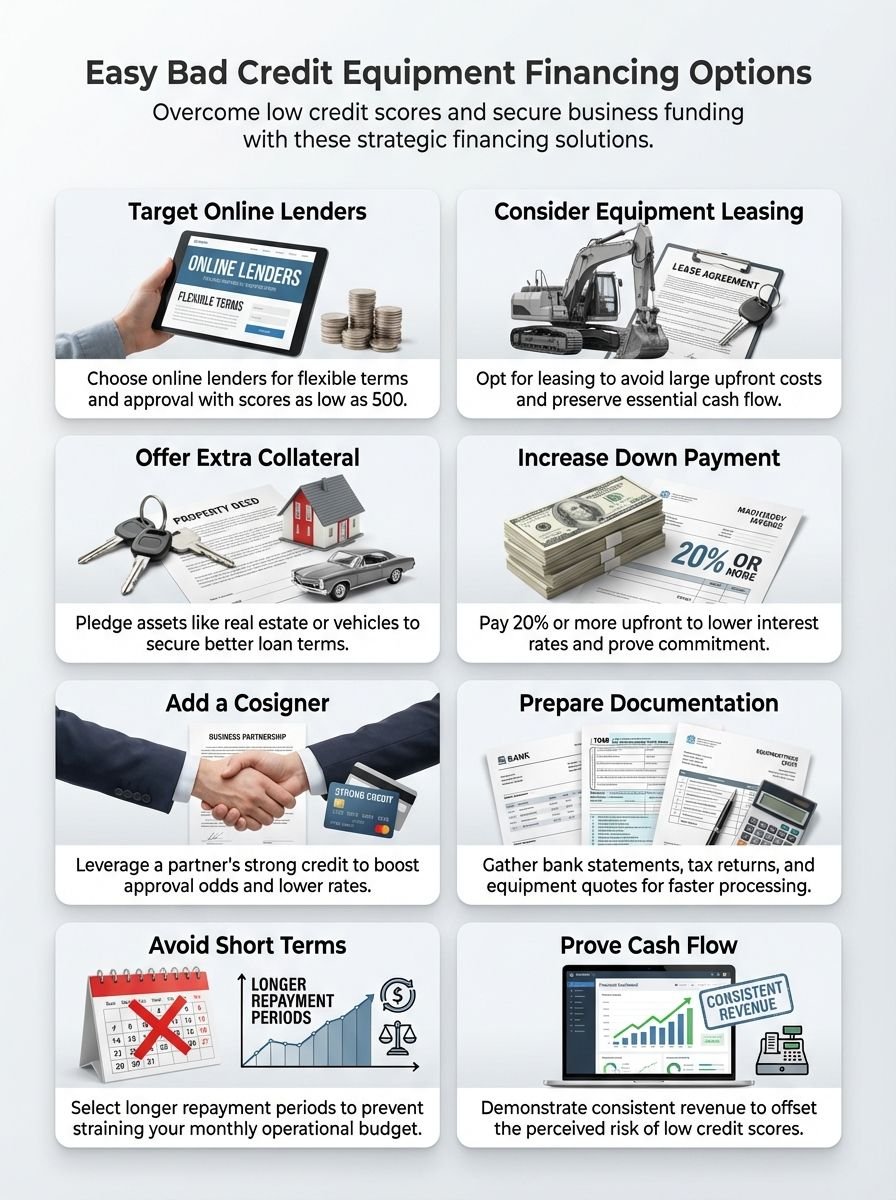
- Offering extra collateral or higher down payments (20% or more) increases approval chances and lowers risks for lenders.
- Leasing is a great alternative to loans. It avoids large upfront costs and allows flexibility in upgrading equipment frequently.
- Online lenders are faster than banks, with approvals in 24–48 hours. Banks have stricter rules and may require better credit scores.
- Documents like tax returns, bank statements, equipment quotes, and legal business registration improve your loan application chances.
Key Challenges of Getting Equipment Loans with Bad Credit
Lenders see bad credit as risky. A low credit score shows poor payment history or too much debt. This makes lenders worry about default, so they may reject the loan or charge higher interest rates, starting at 5.99% for some qualified borrowers.
Most lenders require collateral to reduce their risk. Collateral can include real estate, vehicles, or even cash deposits. Down payments are also higher with bad credit, often 20% or more of the equipment cost.
Some lenders demand proof your business has steady cash flow through bank statements and detailed financial records. Existing liens, bankruptcies, or high balances on current loans also lead to denials quickly.
Poor credit isn’t the end of your financing journey; it just means you need to work smarter.
Best Bad Credit Equipment Financing Options
Bad credit doesn’t mean you’re out of options. Some lenders offer plans to help small businesses get the equipment they need.
National Funding
National Funding helps businesses get equipment financing, even with credit scores as low as 500. They offer flexible loan amounts based on your business needs. Applications require basic documents like a driver’s license, voided business check, and an equipment quote.
They focus on fast approvals, often within one to two business days. There are no upfront costs to apply. Plus, they provide payment options like deferred plans for those who qualify.
With personalized customer service, they support small businesses that may lack strong credit history or face challenges securing loans elsewhere.
Balboa Capital
Balboa Capital offers equipment financing suitable for businesses with credit issues. They accept credit scores as low as 500 to 600, making it accessible for many business owners.
Loans go up to $250,000 and have repayment terms between 2 and 5 years. Approvals are quick, often within 2 to 4 hours.
Funding is fast too; approved applicants can get funds in just one day. Their loans cover both new and used equipment costs, plus soft expenses like freight or installation fees. Applicants need proof of solid cash flow to qualify, but the process is simple and online-friendly.
Triton Capital
Triton Capital offers equipment loans even for businesses with bad credit. They accept credit scores as low as 600. Businesses must have at least two years of operations to qualify.
Loan amounts can go up to $250,000, which works well for buying essential business equipment.
The repayment terms range from 24 to 60 months, giving flexibility based on needs. The application process is quick and funding may be completed in 1–2 business days. Triton finances both new and used equipment without needing extra collateral beyond the purchased item itself.
Applicants must provide recent tax returns and financial reports but face no upfront costs or impact on their credit score during the application phase.
Equipment Leasing: An Alternative to Financing
Leasing equipment helps businesses with poor credit avoid large upfront costs. It offers flexible terms, usually from 24 to 72 months, making it easier to handle payments. Crestmont Capital provides customized leases between $10,000 and $2 million, offering options for both small and large requirements.
Seasonal leases are also available, fitting businesses with varying revenue patterns.
Lease agreements often include maintenance packages but may increase your overall cost. They allow companies to upgrade gear frequently without owning depreciating assets. Businesses can preserve cash flow while some lease payments might qualify as tax-deductible under Section 179.
This option is effective for equipment that quickly loses value or requires frequent replacement in industries like technology or construction.
Tips to Improve Your Chances of Approval
Boosting your chances is easier if you prepare well. Small changes, like offering extra collateral or adjusting payments, can tip the scales your way.
Offer Additional Collateral
Offering extra collateral can improve your chances of getting equipment financing with bad credit. Items like real estate, vehicles, or business inventory can secure better terms on a loan.
Lenders see added collateral as reduced risk, even if your credit score is around 500.
Using more valuable assets might help you qualify for larger amounts. Some lenders offer up to $10 million when strong collateral backs the loan. Be cautious though; missed payments could result in losing these pledged items.
Increase Your Down Payment
Putting down 20% or more can boost your chances of getting equipment financing with bad credit. A bigger payment reduces the loan amount, lowering both interest and monthly costs. It also shows lenders you are serious and willing to share the risk.
Some programs, like those from Crestmont Capital, even skip collateral when a high down payment is made. If your credit score is below 600, this step may improve your loan terms significantly.
Paying more upfront can also make funding faster since fewer conditions apply.
Use a Cosigner
A cosigner with good credit can help you qualify for equipment financing, even if your credit score isn’t perfect. Some lenders may approve loans for people with scores as low as 500 when a cosigner is involved.
The cosigner’s solid financial standing lowers the risk for lenders. This can lead to better loan terms like lower interest rates or longer repayment periods.
The cosigner shares legal responsibility for the loan. If you default, they must repay it. Most lenders will require the cosigner to provide their credit report and personal financial details during the application process.
Because of this, choosing someone you trust and who understands these risks is key. It could be a trusted family member or business partner willing to take that leap of faith in your business goals.
Documentation Requirements for Bad Credit Equipment Financing
Getting equipment financing with bad credit isn’t impossible, but lenders will need specific documents. Having these ready can speed up the process and improve your chances of approval.
- Provide a completed application form with all required details. This shows you’re committed to securing equipment financing for your business needs.
- Submit a valid driver’s license for identity verification. Some lenders may accept state-issued ID cards instead.
- Include a voided business check from your company account. Lenders use this to confirm banking details for loan disbursement or repayment.
- Share several months of recent bank statements. These reflect cash flow and demonstrate your business can handle monthly payments.
- Attach an equipment quote or invoice from the vendor you plan to purchase from. This confirms the type, cost, and condition of the equipment.
- Show tax returns for at least one recent year, if available. Many lenders want to review both personal and business tax filings.
- Prepare financial statements like profit-and-loss reports or balance sheets if requested by the lender. These provide insight into your financial condition.
- Add legal documents proving your business registration is valid and active in its state of operation.
- Have accounts receivable and payable records on hand if applicable to support revenue claims during evaluation.
- Include equipment appraisal documents for high-value items wherever necessary, especially if purchasing used or specialized machinery.
Online Lenders vs. Traditional Banks: Which is Better for Bad Credit?
Online lenders often work better for bad credit borrowers. They offer flexible requirements and accept credit scores as low as 500. Applications are quick and can be done online in minutes, with funding sometimes arriving within 24 hours after approval.
Some even allow deferred payments or offer custom terms to fit your business needs.
Traditional banks have stricter rules for loans. They demand higher credit scores, more paperwork, and solid collateral before approving you. While their interest rates may be lower, they’re harder to access if your credit is shaky.
If time is tight or your score isn’t great, online lenders might be the easier path to getting equipment financing for your business.
How Much Can You Borrow with Bad Credit?
Loan amounts vary depending on credit, equipment needs, and business strength. Crestmont Capital offers up to $500,000 with a simple application or $10 million if you provide full financials.
ClickLease allows up to $20,000 for businesses of any age with a 520 minimum credit score.
Global Financial provides loans as high as $1 million for applicants with at least a 500 score. Time Payment goes up to $1.5 million starting at 550, while Paradigm finances up to $5 million if your business has been active for over two years and holds a minimum score of 600.
Each lender evaluates factors like the type of equipment being purchased and past financial performance before approving an amount.
Pros and Cons of Bad Credit Equipment Financing
Bad credit equipment financing can be a lifeline for many small businesses. But like any financial decision, it has its ups and downs. Here’s a straightforward overview of its advantages and disadvantages:
| Pros | Cons |
|---|---|
| Equipment acts as direct collateral, reducing risk for lenders. | Higher interest rates, often starting at 5.99% or more. |
| Fast approval, sometimes as quick as 2 to 4 hours. | Shorter repayment terms can lead to higher monthly payments. |
| Preserves cash flow, keeping cash reserves intact. | Requires some level of upfront investment, like a down payment. |
| Payments are predictable, aiding budgeting for businesses. | Missed payments could harm credit further and risk repossession. |
| Offers tax advantages for qualifying purchases or leases. | Additional documentation may be necessary, adding time to the process. |
| Allows you to acquire necessary equipment, staying competitive in your market. | Online lenders may have less transparency compared to traditional banks. |
| Flexible repayment terms, ranging from 24 to 72 months. | Some lenders charge high origination or processing fees. |
This balanced table highlights the benefits and challenges. Always weigh your options before making a choice.
Avoiding Common Mistakes in Equipment Loan Applications
Applying for an equipment loan with bad credit can be tricky. Many business owners make avoidable mistakes that hurt their chances of approval.
- Misjudging how much money is needed often causes problems. Borrow too little, and you’ll struggle to buy the equipment. Borrow too much, and paying it back becomes harder.
- Choosing a short repayment period may look cheaper, but monthly payments will likely be higher. This can stress your cash flow.
- Skipping a thorough check of your credit report is risky. Errors on reports can lower scores, making approval harder.
- Applying only to traditional banks wastes time if they don’t specialize in bad credit loans. Online lenders or financing companies for bad credit are better options.
- Not preparing a solid business plan weakens applications. A strong plan shows lenders you’re serious and capable.
- Forgetting complete documentation delays applications or leads to rejections. Lenders need proof of income, past financials, tax returns, and details about the equipment you’re buying.
- Overlooking “no credit check” financing isn’t smart either! It sounds appealing but often comes with high rates and penalties if payments are late.
- Failing to compare multiple lenders ends up costing more in interest or fees later on.
- Offering no collateral makes it harder to secure loans with poor credit scores even though it helps lower lender risks significantly.
- Ignoring payment terms without reading the fine print leads to surprises down the road like hidden fees or stiff penalties for early payoff schedules!
Frequently Asked Questions About Equipment Loans with Bad Credit
Getting an equipment loan with bad credit can feel tricky but is still possible. Below are common questions and simple answers to help you understand how it works.
- Can I get equipment financing with a low credit score?
Yes, many lenders accept scores as low as 500–600. Still, higher interest rates or bigger down payments may apply. - What is the minimum credit score needed?
Some lenders require at least a 550 credit score, while others might have no minimum but charge more fees. - Will leasing be a better option?
Leasing can work if you don’t want strict loan terms, especially for older or used equipment. - Do all lenders check my credit?
No, some offer “no credit check” loans, but these often have higher costs or hidden penalties. - How much down payment do I need?
Most lenders look for 20%, though those with weaker scores might need to pay more upfront. - Is buying cheaper equipment easier to finance?
Yes, less expensive items are safer bets for lenders and need smaller approval amounts. - Can I get approved without years in business?
Yes, startups qualify sometimes too; legal registration and U.S.-based operations are key factors. - Does paying on time improve my credit?
Absolutely! Making timely payments helps boost your score and builds trust with creditors. - How long does it take to get approval?
Online lenders can approve loans quickly—often within 24–48 hours—while banks take longer. - Are there programs for returning customers with poor credit histories?
Some lenders offer perks like lower rates or easier terms for loyal clients who show improvement. - Can I use a cosigner to get better terms?
Definitely! A cosigner with strong credit increases your chances of approval or lowers your rates significantly.
What Are Typical Terms for Equipment Financing?
Interest rates for equipment financing often start at 5.99%. For bad credit, they may climb higher. Loan terms typically range from 24 to 72 months. Payments can be monthly, quarterly, annually, semi-annually, or even seasonal if your business has fluctuating income.
Approval is fast and can take as little as 2 to 4 hours. Once approved, funding usually follows within one or two business days. Lenders may offer up to 100% financing for both new and used equipment, including soft costs like installation or shipping fees.
Some lenders also allow deferred payments through programs like Crestmont Capital’s options. Loan amounts can go up to $10 million if you provide full financial documentation.
Conclusion
Getting equipment financing with bad credit isn’t easy, but it’s possible. Explore lenders who specialize in helping businesses like yours. Consider options like leasing or offering collateral to improve your chances.
Small steps, like boosting your credit score or using a cosigner, can make a big difference. The right loan can help you get the tools you need to grow!
For more detailed information on what to expect, read our guide on typical terms for equipment financing.
FAQs
1. Can I get an equipment loan with bad credit?
Yes, you can. Equipment loans for bad credit are available through lenders who specialize in financing options for businesses with lower credit scores. These loans often focus more on the value of the equipment you’re purchasing than your personal credit score.
2. What types of equipment can I finance or lease with bad credit?
You can finance a wide range of equipment, including heavy machinery, trucks, tools, and other business necessities. Both new and used equipment are typically eligible for financing or leasing.
3. How does my personal credit score impact getting an equipment loan?
Your personal credit score plays a role but isn’t always the deciding factor. Many lenders offering bad-credit business loans consider factors like time in business, collateral (like the equipment itself), and your ability to make payments.
4. Are there alternatives if I don’t qualify for traditional loans?
Yes! Options include merchant cash advances, lines of credit, or even leasing instead of buying outright. These choices may be better suited if you have significant challenges with your credit report.
5. Do I need collateral to secure an equipment loan?
Most times yes; the purchased equipment often serves as collateral for the loan itself. This reduces risk for lenders and makes it easier to get approved despite poor financial history.
6. How do errors on my credit report affect my chances?
Mistakes on your report could lower your score unfairly and hurt approval chances for business financing or leasing needs like this one; correcting them might help improve outcomes before applying
