
Choosing between an equipment finance agreement vs loan can feel confusing. Did you know these two options impact ownership, payments, and costs differently? This guide breaks down the key differences to help you make a clear choice for your business needs.
Keep reading, it’s simpler than you think!
Key Takeaways
- An Equipment Finance Agreement gives ownership upfront, while a loan transfers ownership only after full repayment.
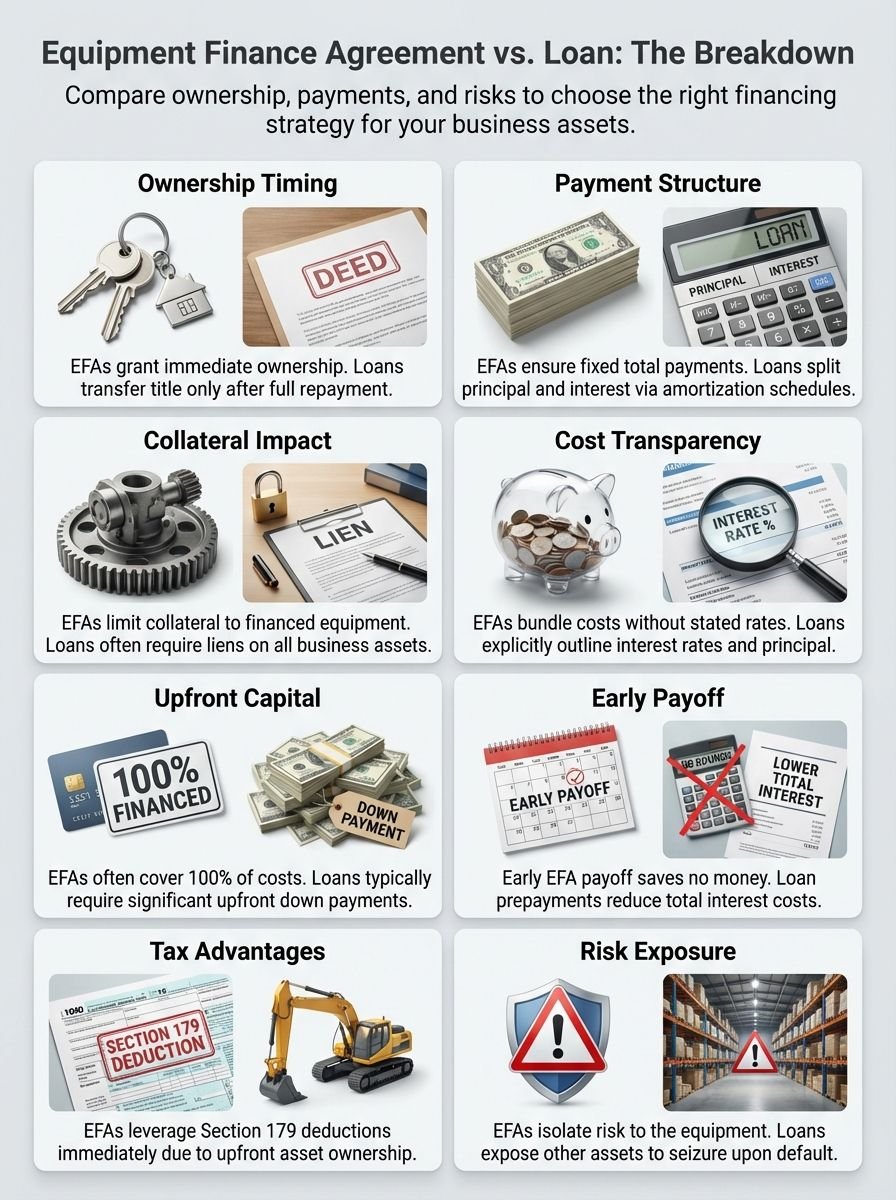
- EFAs have fixed payments without a stated interest rate and use only the purchased equipment as collateral. Loans split payments into principal and interest with possible extra collateral like inventory or real estate.
- EFAs bundle all costs without showing separate interest rates, offering consistent budgeting. Loans provide clear cost breakdowns but may change with market rates if not fixed.
- EFAs suit businesses needing quick approval, 100% financing, and limited collateral risks. Loans work for firms ready to offer strong assets and prefer detailed payment structures over time.
- Section 179 tax benefits apply to EFAs in the purchase year, while loans often require larger upfront expenses but allow flexible partial financing options.
Ownership Differences
Who owns the equipment depends on how you finance it. This choice affects control, taxes, and your balance sheet.
Equipment Finance Agreement: Ownership from the start.
An Equipment Finance Agreement (EFA) gives you ownership of the equipment right away. Once signed, the item is listed as an asset on your balance sheet. This means immediate benefits like equity growth and tax advantages using Section 179 depreciation.
Payments under an EFA are fixed, covering both principal and finance charges without a stated interest rate. Unlike some loans or leases, only the financed equipment acts as collateral.
This setup ensures clear costs while keeping liability for lawsuits tied to the lender’s side at bay.
Loan: Ownership transfers after repayment is complete.
The borrower must finish all payments to own the equipment outright. Until then, the lender keeps a security interest in it. This means no full control or ownership until you pay off the debt completely.
Payments split between the principal and interest follow an amortization schedule.
In many cases, banks require extra collateral beyond just the equipment itself. They might place liens on other assets too, like accounts receivable or even your inventory. Loans can also come with restrictions that limit further borrowing or demand early repayment if conditions change—adding another layer of risk for businesses working with tight budgets.
Payment Structure
Payment plans can feel like a game of numbers. Knowing how costs are split helps you plan better and save money in the long run.
Fixed payments in an Equipment Finance Agreement.
Equipment Finance Agreements secure consistent payments. These payments remain unchanged for the entire term, whether it’s 36 or 60 months. Businesses know the exact amount they owe each month, aiding in budgeting and cash flow planning.
The total cost, including finance charges, is included in these fixed amounts.
Unlike loans that list an interest rate, EFAs don’t display one separately. Paying off early is permitted but won’t reduce the total amount owed. All scheduled payments must still be completed as outlined in the contract terms.
This structure simplifies cost predictions without unexpected changes from market shifts or interest rate variations.
Loan payments include interest and principal, following an amortization schedule.
Loan payments split into two parts: principal and interest. The principal reduces the total debt, while the interest pays for borrowing the money. Each payment follows an amortization schedule, which shows how much goes toward each part over time.
An amortization schedule keeps businesses clear on where their money goes.
Early payments usually cover more interest, with later ones focusing more on reducing the debt. For example, if you borrow $50,000 at 6% for five years, your first monthly payment of $966 may allocate about $700 to interest and only $266 to principal.
By month 60, nearly all of it would chip away at the remaining balance! This structure balances cash flow but requires careful planning.
Collateral Requirements
Collateral can make or break your financing deal, no kidding. Knowing what’s on the line helps you pick the right option for your business needs.
Equipment Finance Agreement: Collateral limited to the financed equipment.
With an Equipment Finance Agreement (EFA), only the equipment you buy serves as collateral. This means your other business assets, like accounts receivable or property, remain untouched by liens.
Unlike traditional loans that can tie up all your assets, EFAs keep it simple and focused on the purchased item.
This setup lets businesses stay flexible. If a company needs more funding later, its remaining assets can still be used. Plus, in case of default, only the financed equipment is at risk—not everything else you own.
This makes EFA safer for those wanting to protect their broader investments while acquiring necessary tools or machines.
Loan: May require a lien on all business assets.
A loan may require a lien on all business assets, covering more than just the equipment. This often includes accounts receivable, inventory, and even real estate. Banks use this as extra security in case of default.
It increases risk for your business because losing multiple assets could cause major setbacks.
Such loans also come with strict covenants that restrict financial freedom. For example, violating a term like missing a payment can force you to repay the entire balance immediately.
This can complicate securing other financing too since lenders see higher risks when liens are tied to everything your business owns.
Cost Transparency
Understanding costs upfront is crucial. Knowing what you’re paying for helps avoid nasty surprises later.
Equipment Finance Agreement: Costs bundled with no stated interest rate.
Equipment Finance Agreements (EFAs) bundle all costs into fixed payments. There is no separate interest rate displayed. Borrowers pay the full contract amount, which includes both the price of the equipment and finance charges.
Payments stay consistent throughout the term, helping businesses plan their budgets better.
The schedule does not split into principal and interest portions like a loan does. If you pay off early, it won’t lower your total cost due to how charges are structured upfront.
This simplicity works well for companies needing stability in financing equipment without worrying about market rate changes or hidden fees.
Loan: Interest rate and costs explicitly outlined.
Loans clearly show the interest rate. This rate can be fixed or change over time, depending on agreements with the lender. Payments are split into two parts: principal and interest.
Businesses often use this to track how much they’ve paid toward owning the equipment.
Lenders provide a set schedule for payments, so costs stay predictable. Transparency helps compare offers from different banks or finance companies. If market rates shift, loan payments might also change unless locked in at a fixed rate.
Businesses may also need a down payment, which affects initial expenses but reduces total loan size.
Best Use Cases
Choosing between these options depends on your business goals. Think about how quickly you need the equipment and whether owning it matters most.
When to choose an Equipment Finance Agreement.
Pick an Equipment Finance Agreement if owning the equipment upfront is a priority. It works well for businesses needing 100% financing, including shipping and setup costs. Small businesses can keep cash flow steady since there are no large upfront payments.
Section 179 tax benefits also apply in the purchase year, lowering taxable income.
This option suits companies planning long-term use of major equipment like medical tools or heavy machinery. It’s faster to get approval than traditional loans, saving time when business needs can’t wait.
The agreement limits collateral to financed items only, protecting other assets from risk during tough times.
Situations where a loan might be a better fit.
A loan fits businesses ready to offer strong collateral, like real estate or equipment. It works well if a company can make a large down payment upfront. For purchases not needing full financing, loans provide flexibility.
Loans suit firms that need clear cost breakdowns with interest and principal spelled out in monthly payments. Businesses planning for long-term repayment often prefer this option too.
If variable rates and strict bank terms don’t scare you, loans may work better than leasing options for acquiring necessary equipment.
Conclusion
Choosing between an Equipment Finance Agreement and a loan comes down to your needs. Do you want ownership right away or after payments? Each option has its perks, like tax benefits or easier payment terms.
Think about your budget and business goals before deciding. The right choice will help your business grow without stretching finances too thin.
FAQs
1. What is the difference between an equipment loan and an equipment lease?
An equipment loan helps you buy the equipment outright, while a lease allows you to use the equipment for a set time without owning it. At the end of the lease term, you may have options like returning or purchasing it.
2. How does using collateral differ in loans versus leases?
With an equipment loan, the purchased item often acts as collateral until it’s paid off. In a lease agreement, ownership stays with the finance company during the lease period.
3. What are some benefits of leasing over buying?
Leasing can lower upfront costs and offer flexibility at the end of your term. It may also provide tax benefits like Section 179 depreciation deduction depending on how your business uses it.
4. Can I own my business equipment after leasing it?
Yes, but only if your agreement includes an option to buy at fair market value or residual value when your lease ends.
5. Which financing option is better for acquiring new technology or medical tools?
Leasing is often preferred for rapidly changing items like technology since it allows businesses to upgrade faster without needing full ownership.
6. Does credit history impact eligibility for both loans and leases?
Yes, lenders check credit scores whether you’re applying for a secured loan or signing up for a rental agreement; strong credit improves approval chances and terms offered by finance providers!
