
Struggling to buy equipment for your business without breaking the bank? An Equipment Financing Agreement (EFA) might be the perfect solution. This guide will explain what is an equipment financing agreement, how it works, and why it’s a great option for many businesses.
Keep reading to learn how EFAs can help you get the tools you need!
Key Takeaways
- An Equipment Financing Agreement (EFA) helps businesses buy equipment with no upfront payment, spreading costs over time. It offers ownership after all payments are completed.
- EFAs provide 100% financing and fixed monthly payments, making it different from traditional loans or leases. The financed equipment serves as collateral.
- Businesses benefit from tax deductions like Section 179 and flexible repayment plans, including early payoff options without penalties.
- Companies with bad credit can still qualify for EFAs through higher interest rates or by showing the value of the equipment being financed.
- Eligible items include medical tools, farm machinery, office furniture, technology upgrades, and commercial vehicles—with both new and used options available for financing.
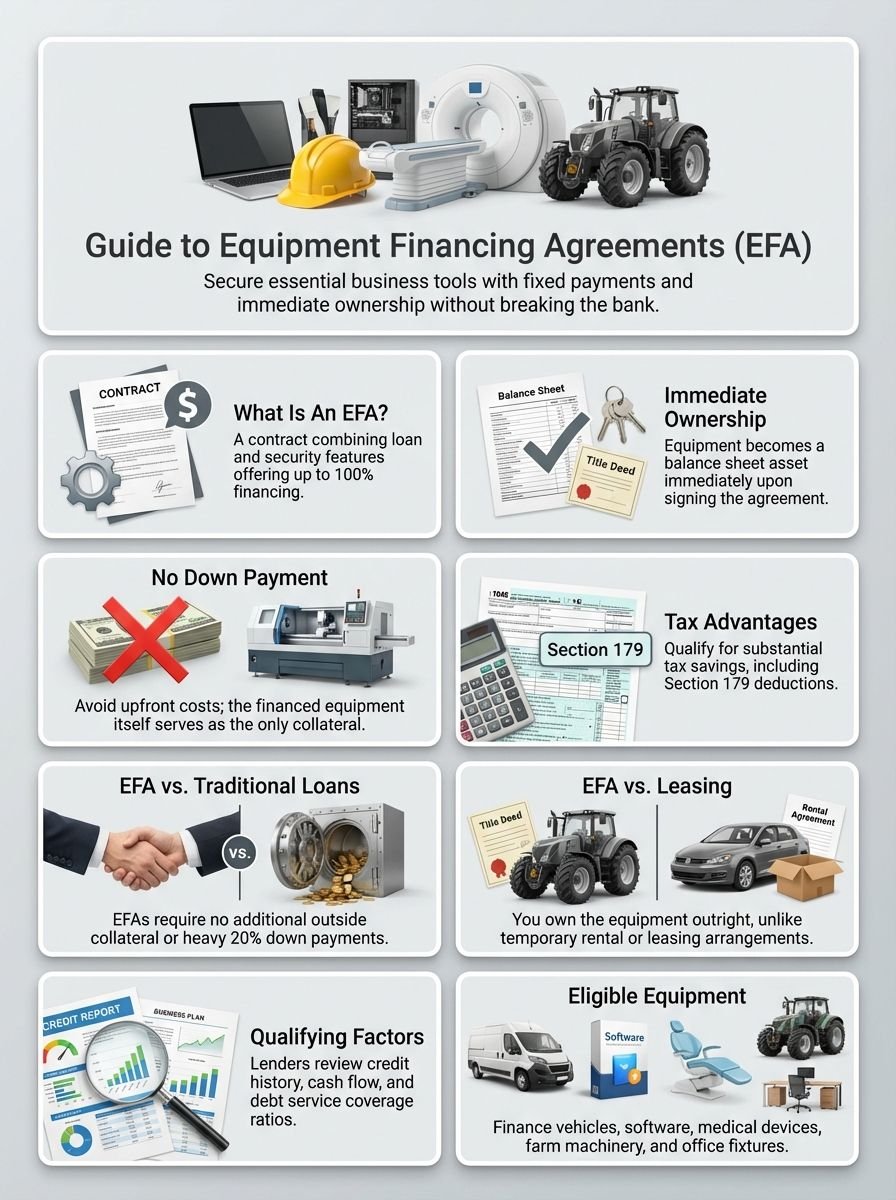
Understanding an Equipment Financing Agreement (EFA)
An Equipment Financing Agreement helps businesses get important tools without paying full price upfront. It’s a simple contract that gives you ownership after making all the payments.
Definition and key features of an EFA
An Equipment Financing Agreement (EFA) is a contract combining elements of a loan, security agreement, and promissory note. Businesses use EFAs to buy equipment immediately while spreading payments over time.
The equipment becomes an asset on the company’s balance sheet right away.
These agreements often allow for 100% financing. This can include extra costs like shipping or installation. Monthly payments are fixed throughout the term, with finance charges included but no separate interest rate shown.
The financed equipment itself acts as collateral, so no additional assets are usually required. Early payoff is possible without penalty but won’t lower total finance charges owed.
How EFAs differ from traditional loans and leases
EFAs offer fixed monthly payments, unlike loans with variable interest rates that can change. Loans often need a down payment of about 20%, covering only part of the equipment cost.
EFAs, on the other hand, usually provide 100% financing with no upfront payment required.
With traditional loans, banks may demand additional collateral like liens on personal assets. EFAs do not require this extra security. Unlike leases where you return or purchase the equipment later, an EFA grants ownership right away after signing.
Lease payments are typically lower each month but don’t transfer ownership until set conditions are met.
Benefits of an Equipment Financing Agreement
An Equipment Financing Agreement helps businesses spread out big costs. It also keeps cash free for other needs, giving companies room to grow.
Ownership advantages and flexible payment terms
You own the equipment outright under an EFA, unlike leasing. This means it becomes a business asset and can be listed on your balance sheet. Ownership also allows you to claim tax benefits like Section 179, with deductions up to $1 million for qualifying purchases.
Many EFAs offer flexible payment plans, making it easier for businesses to manage cash flow. Fixed monthly payments reduce financial strain and bring stability. Some agreements allow early payoff without extra fees if finances improve.
Plus, 100% financing means no large upfront expense is needed to get the equipment you need quickly.
Tailored financing options for businesses
Lenders often shape financing terms to match a business’s needs. Companies like Stearns Bank can adjust the length of an Equipment Financing Agreement. Shorter terms may help reduce total finance charges, saving money over time.
Some lenders offer flexible repayment plans, including quarterly or semi-annual payments. Interest-only periods are also an option for businesses needing breathing room early on. Firms such as First American Equipment Finance guide companies through these choices, making equipment financing simple and fast.
Equipment Financing vs. Leasing: Key Differences
Financing lets you own the equipment, while leasing often means temporary use. Costs and responsibilities also vary between these options.
Comparing liability, ownership, and cost structures
Leasing keeps ownership with the lessor, meaning you avoid liability for depreciation but may face return fees or limits on upgrades. Loans transfer ownership to you after payment, putting depreciation and maintenance on your plate.
Monthly lease payments are often lower than loan payments because you’re not buying the equipment outright.
With loans, interest can be expensed monthly and shown as debt on your balance sheet. Leasing doesn’t show up as a debt, helping keep finances cleaner for credit reviews. Leases allow upgrades more easily, while loans lock you into specific equipment.
Cost differences depend heavily on terms, interest rates, and asset value.
How to Qualify for an Equipment Financing Agreement
Good credit, steady income, and the right paperwork can boost your chances—read on to learn how!
Credit history, down payment requirements, and financial considerations
Lenders check credit history to decide approval. They may review business credit or the owner’s personal score if the company lacks a track record. Strong credit improves chances and lowers interest rates.
A bad score might result in higher costs or rejection.
Down payments vary by financing type. Equipment loans usually need 20% upfront, while equipment financing agreements (EFAs) often skip this requirement. Financial health matters too; lenders evaluate cash flow through debt service coverage ratios to ensure payments fit the budget.
For example, if monthly revenue is $25,000, total loan repayments must stay much lower than that amount.
Equipment Financing Options for Businesses with Bad Credit
Bad credit does not always block businesses from securing equipment financing. Some lenders look at the value of the equipment or cash flow potential instead of just focusing on credit scores.
They may even check the owner’s personal credit if business history is weak.
Options often include higher interest rates or strict repayment terms to offset risks for the lender. Interest-only periods help reduce payments early on, while extended loans spread costs over time.
Proof of equipment value, such as appraisals for used items, might be required too. Businesses can still acquire necessary tools with these options in place, even when facing funding challenges.
Common Types of Equipment Eligible for Financing
Businesses can finance various essential equipment. Common examples include medical devices, computer hardware and software, farm machinery, ovens, tools, and manufacturing machines.
Office furniture and fixtures also qualify if tied to business operations.
Vehicles for commercial use are often eligible too. Both new and used equipment work as long as their value is clear. The financed items must have serial numbers or identifying marks for tracking and collateral purposes.
Equipment like tractors in agriculture or technology upgrades in offices are typical options businesses choose to finance successfully.
Steps to Secure an Equipment Financing Agreement
First, get your financial papers in order and check your credit score. Then, pick a lender who matches your business needs and the equipment you want to finance.
Application process and choosing the right lender
Start by gathering all needed documents. Include proof of revenue, tax identification, and equipment quotes or appraisals. Lenders also require business financial information, like cash flow records and credit history.
Some lenders, such as Stearns Bank or Team Financial Group, offer same-day approval if paperwork is complete.
Choose a lender who understands your equipment needs. Look for competitive terms and flexible payment options that match your budget. Independent financing partners often handle taxes, shipping fees, or insurance costs in their packages.
Consulting a commercial financing expert can help you find the best fit for your business needs while avoiding hidden fees.
Conclusion
An Equipment Financing Agreement can be a game-changer for businesses. It helps you get the tools you need without draining your cash flow. With flexible terms and ownership benefits, it’s a smart way to grow your company.
The equipment itself often serves as collateral, making it less risky than other loans. By choosing this option, business owners can invest in their future with confidence.
For businesses facing credit challenges, explore our guide on equipment financing options for bad credit to discover tailored solutions that can help.
FAQs
1. What is an Equipment Financing Agreement (EFA)?
An Equipment Financing Agreement is a type of loan that helps businesses acquire equipment they need. It allows the borrower to own the equipment while making payments over time, similar to a simple interest loan.
2. How does an EFA differ from an equipment lease?
In an EFA, you own the equipment at the end of the term after paying off the cost and interest. With an equipment lease, you may have options like returning or buying the equipment when the lease ends.
3. What types of equipment can be financed with an EFA?
Almost any business-related machinery or tools can be financed—including costly capital equipment, vehicles, or technology upgrades—depending on your needs and credit risk assessment.
4. What are some benefits of using an EFA for financing?
EFAs offer flexible terms and allow 100 percent financing for necessary purchases without needing upfront payment. They also provide tax advantages like Section 179 depreciation deductions in certain cases.
5. Is collateral required for securing financing under EFAs?
Yes, in most cases, the purchased equipment itself serves as collateral for the loan agreement until it’s fully paid off.
6. Can I deduct taxes when using EFAs to finance my business purchases?
Yes! Many EFAs qualify for tax deductions under U.S.-based rules like Section 179 depreciation deduction; consult financial experts to confirm eligibility based on your situation and location in the United States.
